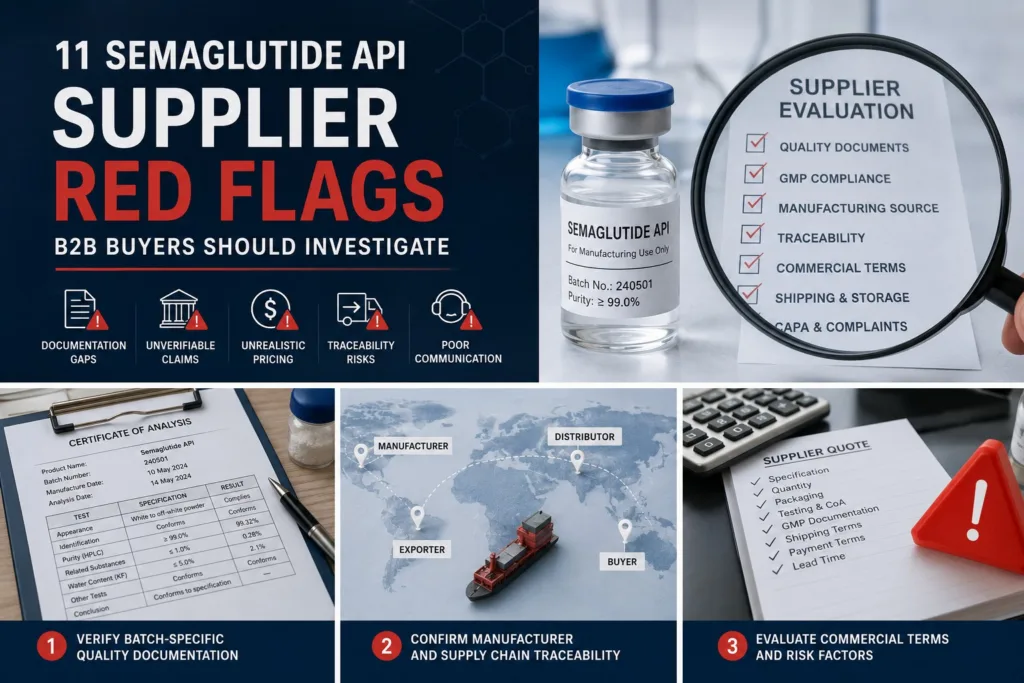
Have you ever wondered what warning signs procurement and quality teams should investigate before approving a Semaglutide API supplier?
The most important Semaglutide API supplier red flags include inconsistent batch documents, unverifiable GMP claims, unexplained pricing, unclear manufacturing roles, weak traceability, and commercial terms that prevent proper due diligence.
Semaglutide is a peptide active pharmaceutical ingredient, or API. Its identity, purity, impurity profile, stability, and batch history should be supported by batch-specific evidence rather than supplier claims alone.
FDA’s Q7 Good Manufacturing Practice guidance for active pharmaceutical ingredients states that it is intended to help ensure APIs are manufactured under an appropriate system for managing quality and meet the quality and purity characteristics they purport, or are represented, to possess. (Source)
For qualified B2B buyers, Pharmint supports documentation-led Semaglutide API sourcing and supplier discovery. However, procurement, QA and regulatory teams must independently evaluate the manufacturer, offered batch, supporting records, commercial counterparty and destination-market requirements before advancing an order.
Why Should Buyers Investigate Semaglutide API Supplier Red Flags Before Procurement?
Supplier red flags matter because weaknesses identified after purchase can delay incoming-material approval, formulation work, regulatory submissions, or production schedules.
A quotation, sample, or document package may support an initial review, but supplier approval should depend on whether the evidence is relevant, consistent, and connected to the material being offered. Buyers remain responsible for qualifying the components they use through their own quality and regulatory review.
A risk-based review therefore asks more than whether a supplier has submitted a file. It asks whether:
- The information applies to the correct product and site;
- The results belong to the offered batch;
- The manufacturer and seller roles are clear;
- Public regulatory claims can be verified;
- Commercial and shipping records identify the same transaction.
The following red flags show where those relationships commonly become unclear.
11 Semaglutide API Supplier Red Flags Buyers Should Investigate
A red flag is an inconsistency, omission, or missing relationship that requires further evidence. One concern may be correctable, but several unresolved warning signs can indicate that the buyer cannot reliably establish the material’s source, condition, or contractual basis.
Red Flag #1: Missing or Inconsistent Semaglutide API Quality Documents
The first red flag is a quality package in which the quotation, product label, certificate of analysis, and analytical records do not describe the same product and batch.
FDA’s Q7 guidance says an API certificate should include the tests performed, applicable acceptance limits, and numerical results. It should also be dated, signed by authorized quality personnel, and identify the original manufacturer.
Buyers should investigate when:
- The batch number is missing or changes between records;
- The product name or grade is inconsistent;
- Numerical results are replaced only by “passes” or “complies”;
- Test, release and retest dates do not align;
- Chromatograms identify another sample or no sample at all;
- Identical results appear across supposedly separate batches.
These issues do not automatically prove that the API is unsuitable. They do prevent the buyer from confirming that the submitted evidence belongs to the material being offered.
The supplier should provide corrected batch-specific records and a written explanation from an authorized quality representative. If the documents cannot be reconciled, the technical review should not proceed.
Red Flag #2: Unverifiable GMP, FDA or Regulatory Claims
A major red flag is a supplier that claims to be “FDA approved,” “FDA registered,” or GMP compliant but cannot connect the claim to the facility manufacturing the offered API.
Buyers should verify:
- The legal name and address of the manufacturing site;
- Whether the supplier is a manufacturer, distributor or broker;
- The authority that issued the referenced evidence;
- The certificate’s scope and validity;
- Whether the stated API activity falls within that scope;
- Whether relevant FDA inspection or enforcement information exists.
The FDA’s Drug Establishments Current Registration Site provides current registration information for drug establishments, but registration does not mean the product is approved or that FDA has verified the submitted information. (Source)
However, FDA expressly states that establishment registration and drug listing do not indicate that a product is approved or that FDA has verified the submitted information.
Further investigation is needed when:
- A certificate names another company or facility;
- Only a cropped or edited certificate is supplied;
- A distributor presents a manufacturer’s credentials as its own;
- “FDA registered” is presented as “FDA approved”;
- The supplier refuses to identify the manufacturing site;
- The claimed regulatory record cannot be independently located.
Buyers can also review Pharmint’s guide to evaluating GMP-certified API manufacturers and its glossary explanation of Good Manufacturing Practice.
Red Flag #3: Semaglutide API Pricing That Does Not Match the Offered Specification
A low price becomes a red flag when the supplier cannot explain how it relates to the product specification, quantity, documentation, packaging, testing, and delivery terms.
Buyers should investigate when:
- The quote is substantially below technically comparable offers;
- The API grade or specification is omitted;
- Documentation is available only after payment;
- Testing or packaging charges appear later;
- The MOQ changes repeatedly;
- The quote expires before technical evaluation can be completed.
Low pricing does not independently prove a quality problem.
The concern is that the offer may exclude important requirements or refer to material different from what the buyer requested.
Procurement teams should compare quotations on the same basis: specification, quantity, packaging, documentation, Incoterms, lead time and payment terms.
Pharmint’s guide to Semaglutide API bulk price factors explains how these variables can affect a quotation.
Red Flag #4: Evasive or Inconsistent Technical Communication
Concern is warranted when sales representatives answer price questions quickly but avoid questions about the manufacturer, testing, quality responsibilities, or batch release.
Warning signs include:
- No named technical or quality contact;
- Contradictory answers from different representatives;
- Refusal to answer material questions in writing;
- Generic responses copied from product listings;
- Pressure to pay before technical questions are resolved;
- Inability to explain who tests and releases the API;
- Changing availability or lead-time claims.
Delayed communication alone is not proof of a supplier problem. The red flag is persistent ambiguity or answers that change when verification is requested.
A credible supplier should be able to distinguish the responsibilities of the manufacturer, testing laboratory, exporter, and commercial seller.
Red Flag #5: Untraceable Batch Origin or Chain of Custody
A traceability red flag occurs when the supplier cannot show how the offered batch moved from the manufacturer through any distributor, warehouse, or exporter involved in the transaction.
Buyers should clarify:
- Who manufactured the batch;
- Who currently owns and stores it;
- Whether brokers or distributors handled it;
- Where it will ship from;
- Whether it has been opened, sampled or relabelled;
- Which entity will appear on the invoice and shipping records.
A trader may legitimately offer material manufactured by another company. The risk arises when that relationship is concealed or when the chain of custody cannot be documented.
The buyer should be able to connect the manufacturer, batch, storage location, seller, and shipment through consistent records.
Red Flag #6: Unclear Manufacturing Capacity or Supply Continuity
Manufacturing transparency helps buyers determine whether the supplier can provide repeat commercial quantities rather than relying on temporary inventory or an undisclosed third party.
Potential warning signs include:
- Unsupported capacity claims;
- Lead times that change without explanation;
- Immediate promises of large quantities without production context;
- No clear response about recurring supply;
- Dependence on an unidentified source;
- No process for communicating interruptions.
FDA’s Q7 guidance addresses the use of suitable facilities, controlled production procedures, and defined quality responsibilities in API manufacturing.
A supplier does not need to reveal confidential process information during an initial inquiry. It should still be able to explain its role, typical lead time, approximate supply capability, and approach to material shortages.
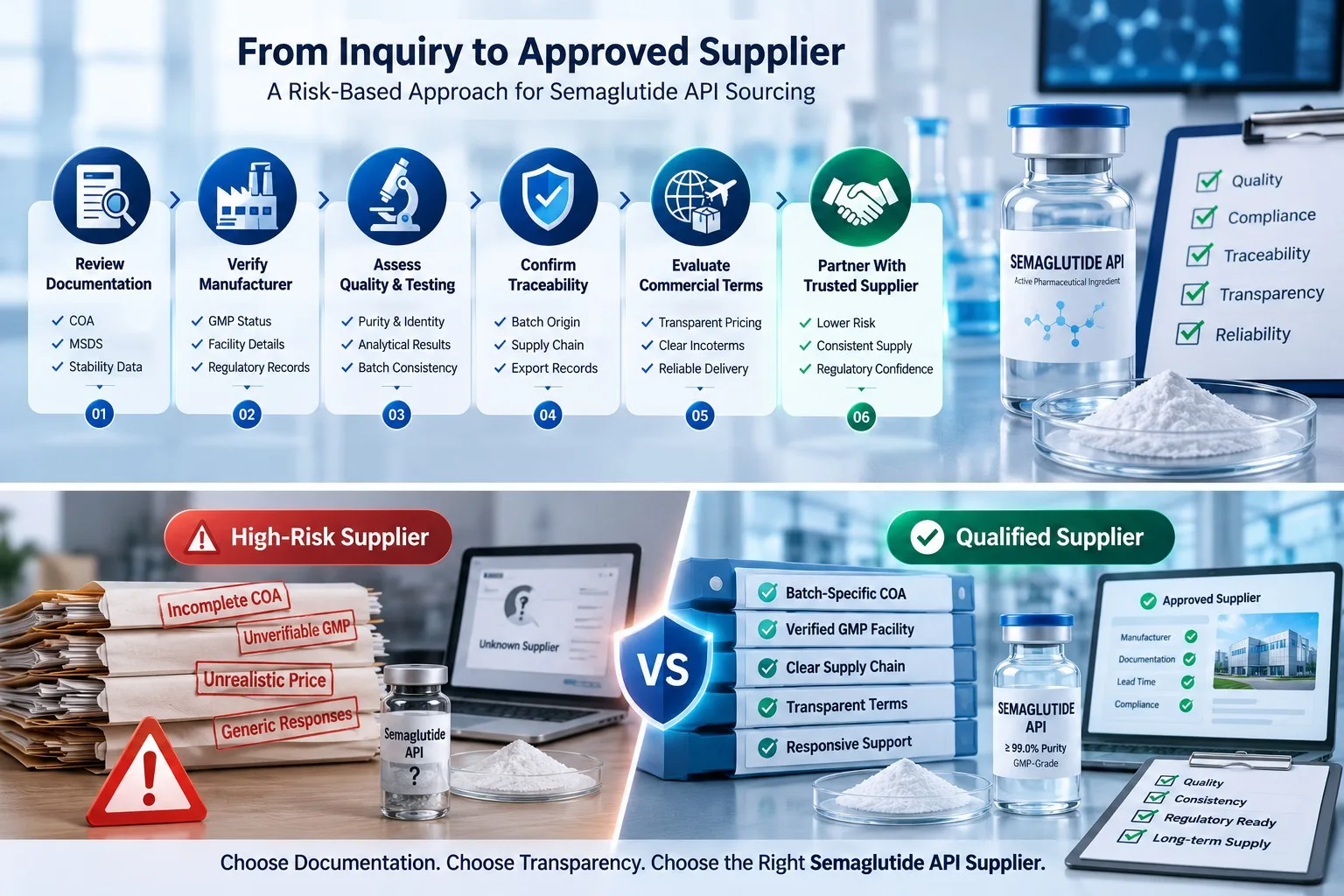
Red Flag #7: Mismatched Company, Contract or Banking Details
Buyers should investigate when the entity receiving payment differs from the company named on the website, quotation, agreement or invoice without a documented explanation.
Warning signs include:
- No verifiable legal company name;
- Different entities across quotations and invoices;
- Bank details belonging to an unrelated person or company;
- Unexplained changes in the payment recipient;
- A location presented as a factory without evidence;
- No distinction between manufacturer, exporter and sales agent;
- Frequent changes in email domains or contact details.
Different entities may legitimately handle manufacturing, exporting and payment. Their relationships must nevertheless be disclosed before funds are transferred.
A professional website or marketplace listing does not replace contractual counterparty verification.
Red Flag #8: Samples That Cannot Be Linked to Commercial Supply
A sample establishes only the quality of the material tested. It does not prove that the commercial order will come from the same batch, manufacturing site, specification or production process.
Buyers should ask:
- Whether the sample came from a commercial batch;
- Whether the same manufacturer will supply the order;
- Whether the sample was repackaged;
- Whether the commercial batch will use the same specification;
- Whether fresh batch documents will accompany shipment;
- Whether sample approval creates any purchase obligation.
A red flag exists when the supplier cannot identify the sample batch or refuses to confirm the relationship between the sample and future material.
Sample acceptance should not replace batch-specific review of the commercial API ultimately supplied.
Red Flag #9: Commercial Terms That Change During Supplier Evaluation
Unexpected changes to payment, quantity, specification, delivery or contracting terms may indicate that the original offer was incomplete or unavailable.
Buyers should pause when:
- Bank information changes shortly before payment;
- The payment recipient differs from the contracting party;
- The MOQ rises after sample approval;
- The specification changes after price agreement;
- Delivery responsibilities disappear from the final invoice;
- Payment is requested before the manufacturer is identified;
- The supplier refuses to issue a formal quotation.
The U.S. International Trade Administration explains that cash-in-advance is the most secure payment method for the exporter because the importer pays before shipment. (Source)
From the buyer’s perspective, this creates greater exposure to counterparty and shipment risk.
Advance payment may be commercially appropriate, but the buyer should first verify the counterparty, scope, refund conditions, and shipping obligations. Changed bank instructions should be confirmed through a previously authenticated communication channel.
Red Flag #10: Undefined Storage, Packaging or Shipping Conditions
Material quality may be affected when storage requirements, packaging controls, shipment responsibilities, or excursion procedures are not defined.
Before shipment, buyers should confirm:
- The packaging configuration;
- Container sealing and tamper evidence;
- Labelled storage conditions;
- Whether temperature monitoring is required;
- Who prepares export and import records;
- Who manages transit deviations;
- How the batch will be identified on arrival.
Concern is warranted when a supplier provides conflicting storage instructions, cannot describe the packaging or refuses to define responsibility for transit problems.
Shipping conditions should be based on approved product or stability information, not an informal sales assurance.
Red Flag #11: No Defined Complaint, Deviation or CAPA Process
The buyer may have no reliable route for investigating an out-of-specification result, damaged shipment, labelling error or recurring batch problem.
A supplier should be able to explain:
- Where quality complaints are submitted;
- Who investigates them;
- How affected material is identified;
- When the buyer receives a response;
- How corrective and preventive actions are documented;
- How critical changes are communicated.
Warning signs include:
- Complaints handled only by sales staff;
- Replacement offered without investigation;
- No written acknowledgement;
- No root-cause analysis;
- Repeated failures without preventive action;
- No defined notification responsibilities.
A replacement may solve the immediate commercial problem, but it does not establish why the issue occurred or whether other material is affected.
Semaglutide API Supplier Due-Diligence Checklist
Before approving a supplier, confirm that:
- The COA identifies the exact product, specification, and batch;
- Analytical records match the reported results and batch identity;
- The manufacturing site is disclosed;
- GMP and registration claims are independently verifiable;
- Pricing reflects a defined technical and commercial scope;
- Technical questions receive consistent written answers;
- Batch origin and custody are traceable;
- Supply capacity and lead times are credible;
- Legal, contractual and banking entities are explained;
- Samples are linked to the proposed commercial supply;
- Payment and delivery terms remain consistent;
- Storage and shipping responsibilities are documented;
- Complaints and CAPA follow a defined quality process.
One missing item may require clarification. Several unresolved inconsistencies should trigger escalation or suspension of the supplier review.
What Should Buyers Do When Found a Semaglutide API Supplier Red Flag?
A red flag should trigger proportionate verification rather than an automatic conclusion.
The buyer should:
- Record the specific inconsistency;
- Request objective supporting evidence;
- Assign QA, regulatory, procurement, or legal review as appropriate;
- Set a written deadline for clarification;
- Document the final approval, rejection or escalation decision.
The transaction should not advance unless:
- The manufacturer cannot be identified;
- Batch evidence remains inconsistent;
- Regulatory claims cannot be verified;
- Payment instructions cannot be authenticated;
- Material origin or custody is unclear;
- Serious quality concerns have no investigation route;
- Records appear altered or intentionally misleading.
FDA expects drug-manufacturing data to be reliable and accurate and recommends risk-based strategies to prevent and detect data-integrity problems.
How Pharmint Supports Documentation-Led Semaglutide API Supplier Discovery
Pharmint helps qualified importers, distributors, formulation manufacturers, CRO/CDMO teams, and procurement professionals compare Semaglutide API suppliers through documentation-led, quote-based sourcing.
Buyers can use Pharmint to:
- Submit a defined product and quantity requirement;
- Request available supplier options;
- Communicate required documentation;
- Compare commercial terms;
- Discuss destination-country and export needs;
- Request a bulk quotation.
Pharmint does not replace the buyer’s QA, regulatory, legal or import review. Buyers remain responsible for independently assessing each Semaglutide API supplier red flag, verifying submitted evidence and confirming whether the proposed transaction is permitted in the destination market.
Need supplier options for a qualified B2B requirement? Review the Semaglutide API product page and submit the required quantity, destination country, buyer type, intended use, and requested documents.
Compliance Disclaimer
This content is intended for qualified B2B pharmaceutical procurement, quality, regulatory, manufacturing, and research professionals. It is not intended for direct consumer purchasing, self-medication, dosage guidance or personal use.
Product availability, supplier documentation, specifications, pricing, export eligibility and shipping conditions are supplier-specific. Buyers must independently confirm supplier suitability and all licensing, import, registration, end-use and regulatory requirements applicable to the destination market.
Frequently Asked Questions About Semaglutide API Supplier Red Flags
Does a COA Prove That Semaglutide API Is Authentic?
No. A COA reports batch test results, but buyers must verify that it identifies the correct manufacturer, product, batch, specification, and authorized quality approval.
Does FDA Registration Mean a Semaglutide API Supplier Is FDA Approved?
No. FDA states that registration and listing do not indicate product approval or verification of the submitted information. Buyers must evaluate the relevant facility and records separately.
Is an Unusually Low Semaglutide API Price a Supplier Red Flag?
Not necessarily. It becomes a red flag when the supplier cannot explain the specification, quantity, documentation, packaging, shipping, and payment assumptions behind the quote.
Can a Distributor Legitimately Supply Semaglutide API?
Yes. A distributor may supply legitimate API when it clearly identifies the manufacturer, preserves batch traceability and explains its role in storage, sale and shipment.
Should Buyers Approve a Semaglutide API Supplier Based on a Sample?
No. Sample approval applies only to the tested material. Buyers should still review the documents and acceptance results for the commercial batch that will be shipped.
What Should Buyers Do When Semaglutide API Supplier Documents Conflict?
The buyer should pause the review, identify each discrepancy, and request corrected batch-specific records plus a written explanation from an authorized quality contact.
When Should Buyers Reject a Semaglutide API Supplier?
Rejection or formal escalation may be appropriate when the manufacturer is concealed, records appear falsified, payment cannot be authenticated, or serious quality concerns remain unresolved.