

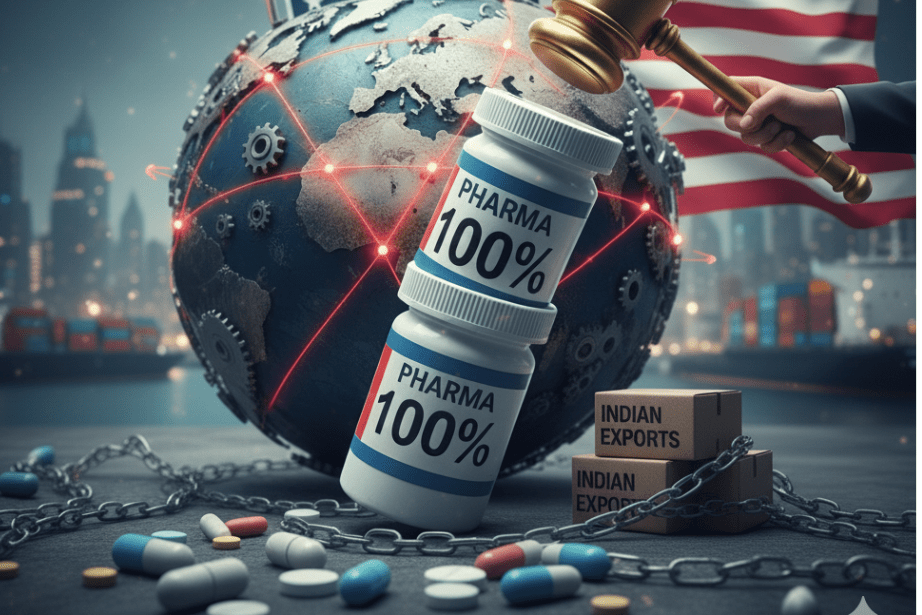
What happens when the world’s largest exporter of generic drugs is targeted by a potential 100% import duty from the world’s largest pharmaceutical consumer?
The announcement of a Trump 100% pharmaceutical tariff, proposed as part of the former U.S. President’s 2025 trade policy comeback, has sent a clear signal to global pharmaceutical manufacturers, especially in India.
Did you know that India supplies nearly 40% of the generic medicines used by American patients?
This policy threatens to disrupt critical drug supply chains, elevate healthcare costs, and force a realignment of global manufacturing hubs.
At the core of this issue lie several interconnected entities:
- The U.S. Food and Drug Administration (FDA), which approves India-based manufacturing plants, has approved Indian pharma majors like Sun Pharma, Dr. Reddy’s, and Aurobindo.
- The World Trade Organization (WTO), oversees trade compliance, and industry stakeholders such as Pharmexcil, representing India’s drug exporters.
- The move could reshape regulatory pathways, increase production costs for U.S. healthcare providers, and demand strategic responses from Indian pharmaceutical firms already stretched across global value chains.
At Pharmint, we see this policy moment as far more than a headline — it’s a pivot point for the global pharmaceutical trade ecosystem. As one of the world’s leading B2B pharmaceutical marketplaces, providing API and drug ingredient sourcing, product registration support, cost‑calculator tools, and trade finance & verification services, we are uniquely positioned to interpret how the Trump 100% pharmaceutical tariff could ripple across supply chains, export strategies, and pricing dynamics.
Through our lens — grounded in active transactions and cross‑border trade intelligence — we’re assessing the macro impact on India’s pharma sector, and how individual suppliers, traders, and global buyers will adapt.
In this article, we’ll explore not just what the proposed tariff means, but why it matters, who it affects, and how Indian pharma can respond strategically.
What Exactly is Trump’s Proposed 100% Pharma Tariff & Why Is India So Exposed?
In 2025, U.S. President Donald Trump announced a bold reintroduction of his “America First” trade doctrine — this time aimed squarely at the pharmaceutical supply chain. His proposal: a 100% import tariff on pharmaceutical drugs and medical products unless companies relocate manufacturing to the United States.
This policy is part of a broader Buy American push, targeting supply chain dependencies exposed during the COVID-19 pandemic. While the administration justifies the move as a way to bring drug manufacturing jobs back to the U.S., critics warn that it risks disrupting global pharmaceutical flows, with India bearing the brunt.
Why Is India the Most Affected with Tariff Increase?
Because India has become the linchpin of global generic drug supply — and the single largest exporter of generics to the U.S.. As of 2024, India supplied:
- 40% of all generics are used in the U.S. healthcare system
- More than 500 U.S. FDA–approved manufacturing facilities
- Over $4.5 billion in annual exports of finished formulations, APIs, and OTC products to the U.S.
This dominant position was built on low-cost production, strong regulatory compliance, and economies of scale that few other countries could replicate. Indian pharma giants — including Cipla, Lupin, Sun Pharma, and Dr. Reddy’s – have become trusted suppliers to American hospitals, pharmacies, and insurance-backed care providers.
Yet, that same centrality now makes India deeply vulnerable to sudden trade realignments. The proposed Trump 100% pharmaceutical tariff isn’t just a political talking point — it represents a possible structural shock to India’s export-driven pharmaceutical model.
With this context in place, we now turn to the economic, supply chain, and global market risks this policy poses and what may unfold if such a tariff is enacted.
What will be the Economic & Supply Chain Fallout of These Tariffs?
The ripple effects of a 100% pharmaceutical import tariff from the U.S. could send shockwaves through India’s pharma economy.
According to industry reports, exports of Indian pharmaceutical products to the U.S. rose by over 20% to reach approximately USD 10.5 billion in FY 2024–25 (source).
This underscores just how deep the dependency between the two countries runs.
How Big Is the Exposure?
While the tariff policy remains in the proposal stage, even partial enforcement could result in:
| Scenario | Potential Disruption | Key Impacted Areas |
| 25% enforcement | ~$2.5B at risk | Mid-margin generics, APIs |
| 50% enforcement | ~$5.0B+ at risk | Formulations, injectables, key oral solids |
| Full enforcement | ~$10.5B at risk | Comprehensive supply breakdown to U.S. buyers |
The U.S. generic drug supply chain is highly price-sensitive. A blanket tariff would price many Indian formulations out of insurance networks, creating a scramble among hospitals, PBMs, and retail chains for alternatives.
Will the U.S. Face Drug Shortages?
Yes, especially for high-demand chronic medications such as those for hypertension, cholesterol, diabetes, and infections. Supply-side constraints could lead to:
- Shortages of critical medicines across therapeutic categories
- Delayed treatments in emergency and low-income settings
- A sudden rise in healthcare expenditure, especially in Medicare and Medicaid budgets
These shortages would likely push U.S. purchasers toward China, Mexico, or European sources—none of which match India’s cost-efficiency or production scale. For the U.S., that means higher prices and greater strategic dependence on politically volatile supply chains.
A Global Pharmaceutical Domino Effect
This isn’t just a bilateral issue. If tariffs reduce India’s pharma output, it could cause:
- Stockpiling behavior in Europe and Africa
- Logistical bottlenecks in ingredient procurement
- Increased risk of regulatory non-compliance due to rushed supplier shifts
India’s global position makes it a pharmaceutical keystone country—pulling one brick risks collapsing regional supply stability.
Next, we’ll look at how this external shock could trigger domestic imbalances—from overcapacity to pricing pressure in India’s own pharmaceutical ecosystem.
How Could India’s Domestic Pharma Market Be Affected?
A sharp contraction in pharmaceutical exports to the U.S. won’t just hurt India’s foreign exchange inflows. It could trigger a domestic supply glut with ripple effects across pricing, production, and policy.
Will India Face Overcapacity?
Yes. Indian pharmaceutical companies maintain large-scale formulation lines, API facilities, and distribution systems tailored for high-volume exports. If major U.S.-bound orders dry up, these plants could face:
- Significant underutilization (especially in high-throughput generics)
- Cost inefficiencies from idle capacity
- Increased pressure to redirect inventory to domestic or alternate global markets
This overcapacity won’t be easily absorbed. India’s domestic market is highly fragmented, price-regulated, and saturated with branded generics and low-margin SKUs.
Could Prices of the Medicines Drop or be Distorted?
In the short term, yes. A sudden influx of re-routed products into the local market may lead to:
- Price wars among Indian manufacturers, especially in Tier-2 and Tier-3 cities
- Disruption to public procurement programs like Jan Aushadhi
- Greater complexity for the Central Drugs Standard Control Organization (CDSCO) to track and regulate over-supplied molecules
However, this pricing pressure may not benefit patients equally. It could cause some companies to cut R&D budgets, delay new product launches, or reduce investment in regulatory upgrades, which could harm long-term domestic innovation.
What Are the Strategic Risks?
Even proactive pivots to new markets carry challenges. Exporting to Africa, LATAM, or Southeast Asia requires:
- New drug dossiers, registrations, and approvals
- Different compliance regimes and documentation burdens
- Pricing adjustments and longer payment cycles, which strain working capital
Furthermore, companies that invest heavily in backward integration or automation to serve the U.S. may find those investments underperforming if tariff enforcement undermines return expectations.
In essence, the Trump 100% pharmaceutical tariff could trigger a misalignment between production scale and market absorptive capacity—an efficiency crisis that regulators and business leaders must confront together.
Next, we’ll explore the most realistic strategic responses available to Indian pharma, ranging from manufacturing relocation and trade diplomacy to innovation and diversification strategies.
How Should Indian Pharma Respond to This Tariff Threat?
India’s pharmaceutical sector has weathered global disruptions before – from price control crackdowns to pandemic-driven API shortages. But a full-scale import tariff from the U.S. would require simultaneous multi-pronged adaptation: strategic, diplomatic, operational, and regulatory.
Here are the most viable response pathways:
Should India Diversify Its Export Markets?
Absolutely. Over-dependence on the U.S. makes India vulnerable to policy shocks. Africa, Latin America, Southeast Asia, and Central Asia represent emerging growth markets.
Diversification success depends on:
- Country-specific regulatory onboarding
- Tailored price benchmarking and packaging strategies
- Public-private partnerships to build brand visibility and distribution capacity
Indian firms already present in sub-Saharan Africa (e.g. Cipla) have shown that sustained effort leads to trust and long-term returns.
Will R&D and Innovation Matter More Now?
Yes. As price-driven generics face tighter margins, Indian pharma must pivot toward higher-value molecules—especially in:
- Biosimilars and biologics
- Complex generics (e.g., injectables, inhalables)
- Niche therapies like oncology, orphan drugs, and personalized medicine
Indian companies must also streamline clinical trial pipelines, forge IP licensing deals, and seek accelerated pathways in markets beyond the U.S.
Can Trade Diplomacy or Legal Channels Help?
India has the option to:
- File a WTO dispute under TRIPS compliance
- Trigger a review via bilateral trade frameworks
- Use FTA negotiations (e.g., India-U.S. talks or IPEF) as leverage to carve out pharma exemptions
Pharmexcil, India’s pharma export council, has urged the Indian government to preemptively engage with U.S. trade representatives to seek exemptions for life-saving generics and FDA-registered supply chains.
What Role Do Industry Alliances and Public Advocacy Play?
Enormous. Collaborative lobbying by Indian pharma firms, U.S. health advocacy groups, and global NGOs could spotlight the humanitarian cost of cutting off affordable drug access.
At PharmInt.net, we believe that Indian pharma needs to mobilize its global narrative—as a life-saving engine, not just a trade partner. This involves strategic storytelling, data-backed impact modeling, and unified representation at international forums.
The proposed Trump 100% pharmaceutical tariff is more than a trade irritant; it’s a stress test of India’s agility, diplomacy, and innovation. Strategic responses must be timely, data-driven, and long-range to minimize exposure and transform adversity into realignment.
Next, we’ll look at quantitative models and projections—estimating best-case and worst-case outcomes across revenue, costs, and market positioning.
Conclusion: Where Does Indian Pharma Go From Here?
Whether or not the proposed Trump 100% pharmaceutical tariff becomes policy, the message to Indian pharma is clear: dependency on a single export market is no longer a risk worth taking lightly.
In this volatile landscape of shifting regulations, rising trade barriers, and evolving geopolitical alignments, resilience will favor companies that act now—not later.
At Pharmint, we help pharmaceutical businesses, policymakers, and analysts anticipate disruption, identify emerging growth corridors, and execute smarter export strategies backed by contextual intelligence and policy insight.
📢 Ready to build a future-proof pharma strategy? Tap into our intelligence briefings, market-entry frameworks, and risk-mitigation models designed for Indian pharma navigating the global stage. Sign up as seller today!
FAQs – US Pharma Tariffs
What happens if U.S. pharma buyers switch from India to China?
U.S. buyers switching to China may increase dependency on politically volatile supply lines. This switch risks higher costs, supply gaps, and regulatory friction with FDA compliance enforcement on non-Indian manufacturers.
How does a pharmaceutical import tariff affect drug affordability in the U.S.?
A pharmaceutical import tariff raises production costs for generic drugs, causing insurers and hospitals to adjust formularies, which leads to higher out-of-pocket prices for American patients and reduced drug accessibility.
Could Indian biosimilars replace lost U.S. generic business?
Indian biosimilars can partially replace lost generics, but require separate FDA pathways, higher R&D investment, and long-term strategic shifts toward complex molecule development and global regulatory acceptance.
Will U.S. patients lose access to critical medications if India is cut off?
If India is cut off, U.S. patients could face delays in critical medication access, especially for diabetes, hypertension, and infectious disease treatments, due to lack of immediate alternative supply chains at scale.
Can India challenge U.S. pharma tariffs through WTO mechanisms?
India can challenge U.S. pharma tariffs at the WTO under TRIPS and MFN clauses, but dispute settlement timelines are long and require multi-lateral support, with no guarantee of reversing the tariff.