


Bulk Tirzepatide API procurement in Nigeria is a regulated business-to-business process, not a retail purchase. A qualified buyer must establish the intended use, define the material precisely, qualify the manufacturing site and batch evidence, obtain the required Nigerian authorization, and control the shipment through receipt and quality release.
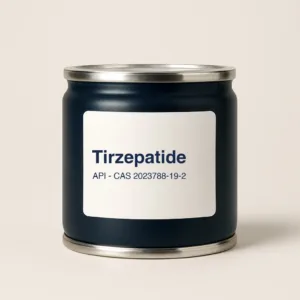
Buy Tirzepatide API for Bulk B2B Sourcing (CAS 2023788-19-2)
Pharmint helps qualified B2B buyers source Tirzepatide API through documentation-led supplier discovery, bulk quote support, and regulated procurement coordination. This page is intended for pharma importers, distributors, formulation manufacturers, CRO/CDMO teams, QA/RA teams, procurement teams, and regulated institutional buyers evaluating bulk Tirzepatide API supplier options. Tirzepatide is a peptide active pharmaceutical ingredient associated with the GLP-1 / GIP receptor agonist category and weight management therapeutic segment at the finished-drug level. Pharmint supports sourcing conversations for qualified buyers seeking pharmaceutical-grade bulk API material with supplier documentation, export support, and compliance-aware inquiry handling. Discuss COA/MSDS Requirements
The correct sequence is important. A low price or supplier-provided Certificate of Analysis does not establish that a batch is suitable for your use or that it can be imported into Nigeria. Start with your regulatory route and user requirement specification, then request comparable quotes from suppliers that can support both.
NAFDAC Requirements for Importing Tirzepatide API into Nigeria
First confirm which legal entity will import, store, and use the API. Depending on the transaction, that may be a licensed finished-pharmaceutical-product manufacturer, marketing authorization holder, importer, distributor, broker, or qualified research or health institution.
NAFDAC’s official API-import guidance states that APIs should not be imported without a permit or authorization. It covers commercial importers and distributors, Nigerian manufacturers, brokers, and institutions importing for research and development. The same document distinguishes commercial requirements from an institutional research route.
NAFDAC published updated Guidelines for Importation of Active Pharmaceutical Ingredients in March 2026 (Source). All applications must now be submitted through the National Single Window and the B’Odogwu platform. Confirm the current portal, forms, tariff, document list, and institutional limits directly with NAFDAC before committing funds or shipping material.
An API import permit is also not the same as marketing authorization for a finished Tirzepatide product. If your project involves formulation, registration, clinical research, compounding, distribution or sale, obtain Nigerian regulatory advice for that activity as well as the raw-material import.
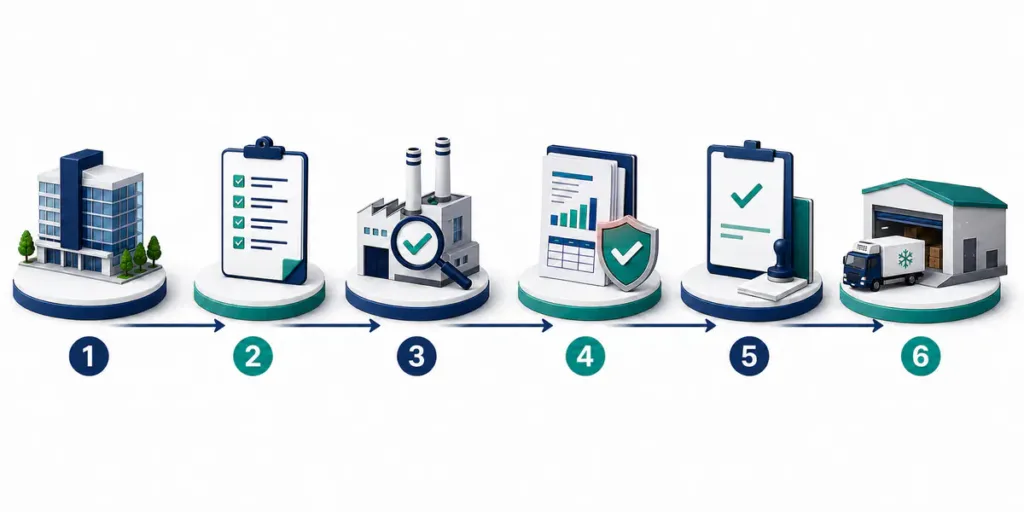
How to Define Your Bulk Tirzepatide API Requirements
Before contacting suppliers, convert the intended use into a written user requirement specification. This keeps quotations comparable and helps ensure that the offered material, manufacturing site, documentation, packaging and transport conditions support the buyer’s Nigerian regulatory pathway.
API, Research Material and Finished Products: What Is the Difference?
Tirzepatide API is a drug substance used in the manufacture or study of a medicinal product. It is not a prefilled pen, vial, compounded preparation or consumer medicine. PubChem identifies Tirzepatide under CAS 2023788-19-2, but a name or CAS number alone is not enough to qualify a purchase.
Your specification should identify the exact chemical form and composition, intended use, required grade, analytical requirements, packaging, storage conditions, and regulatory support. Confirm whether the offered material, manufacturing route, and site match your development or registration file. Do not accept a substitute salt, counter-ion, non-pharmaceutical grade, repackaged material or different manufacturing site without formal quality and regulatory assessment.
Note that research institutions may import research-grade APIs under a separate NAFDAC authorization pathway.
What to Include in Your Bulk API RFQ
A useful RFQ lets qualified suppliers quote the same requirement. Include:
- buyer company, destination, licence category and intended use;
- Tirzepatide name, CAS reference and exact form required;
- target quantity, sample quantity and forecast;
- required specification and analytical methods;
- batch size and preferred number of available batches;
- packaging configuration and container-closure requirements;
- manufacturer-recommended storage and transport conditions supported by stability data;
- required documents, including DMF or ASMF support and Letter of Access where applicable;
- requested batch CoA, SDS, GMP evidence, stability data, impurity information and change-control history;
- delivery location, Incoterm, target date and customs information;
- independent-sample-testing and supplier-audit expectations.
For broader sourcing, Pharmint’s category for bulk APIs and pharmaceutical raw materials can help procurement teams organize comparable supplier options.
How to Choose a Tirzepatide API Manufacturer and Supplier
Supplier selection should separate the commercial seller from the legal manufacturer and every site involved in production, testing, release, packaging and export. Evaluate regulatory evidence, quality systems, analytical capability, change control and supply continuity before using price or lead time to choose a source.
Verify the Manufacturer and Production Site
Identify who synthesizes, purifies, tests, releases, packages, stores and exports the API. A trader’s name is not a substitute for the legal manufacturer and exact production site.
Request current, site-specific evidence of GMP compliance and verify it with the issuing authority where possible. Review the inspection scope and dates, manufacturing authorization, quality-system history, ownership, subcontractors, and whether critical steps occur at another site.
NAFDAC’s API GMP guideline effective 18 June 2025 explains that GMP expectations increase as production advances through API processing, purification, physical processing and packaging. For a complex peptide, supplier qualification should therefore examine the complete relevant chain rather than a sales certificate in isolation.
Review the Quality and Regulatory Dossier
For most commercial applicant categories, NAFDAC’s hosted API-import guideline calls for a DMF or equivalent documentation, current GMP evidence, a Letter of Access where relevant, and supporting company and premises documents. It also requests Certificates of Analysis from three commercial-scale batches whose test-release dates are no more than six months old at application.
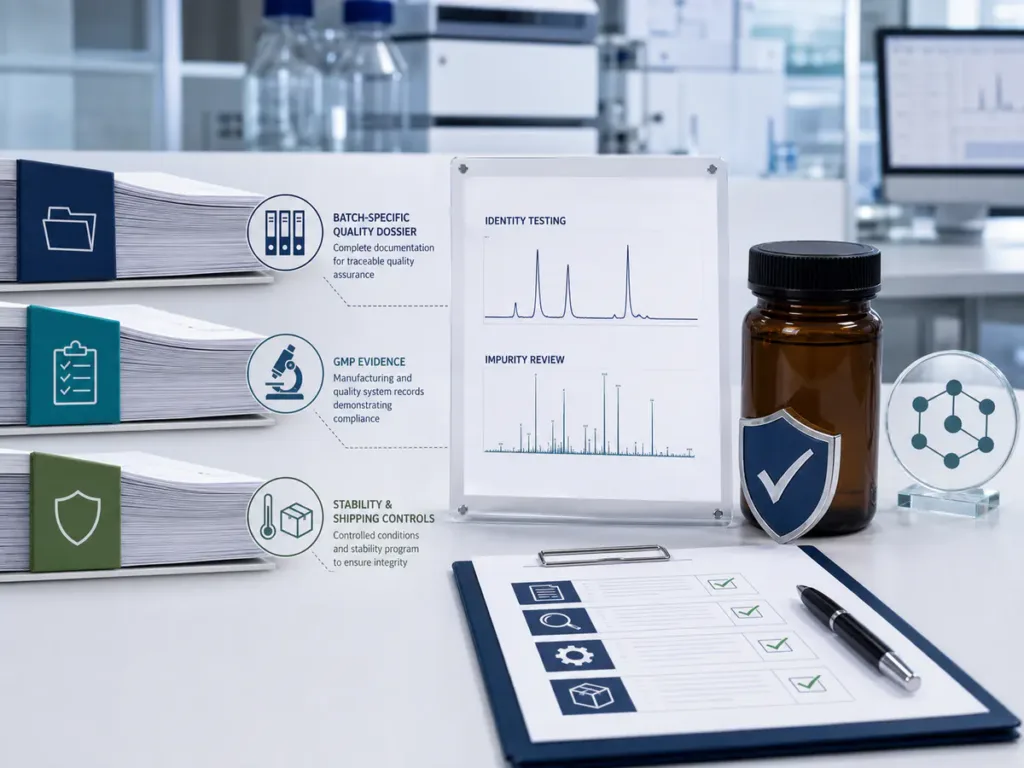
Ask the supplier for:
- a batch-specific CoA and approved specification;
- identity and assay or content methods appropriate to the material;
- related-substance and impurity information, including identified and unidentified impurities;
- water, residual-solvent and relevant elemental-impurity results;
- bioburden, endotoxin or microbiological controls where required by the intended use and specification;
- analytical method summaries and validation or verification support;
- representative chromatograms and identity evidence;
- stability protocol, available data and proposed retest period;
- packaging, labelling, storage and transport instructions;
- DMF or ASMF status, open-part information and Letter of Access process;
- current manufacturing-site GMP evidence and recent inspection history;
- deviation, out-of-specification, complaint, recall and change-notification procedures.
Pharmint’s guide to COA, SDS and regulatory-document review provides useful background, but the Tirzepatide dossier still needs product-, site- and batch-specific review.
Test a Representative API Sample Before Scale-Up
Do not treat a supplier sample as proof that every future commercial batch will match. Use a documented sampling plan, verify chain of custody, and test through your qualified laboratory against an approved specification. At minimum, confirm identity and the critical quality attributes relevant to your project. Where appropriate, compare the supplier’s methods and results with independent findings.
Resolve discrepancies before a purchase order. The supply and quality agreements should state how samples relate to production batches, how changes are reported, and what happens when a batch fails specification. Pharmint can also help buyers explore quality-inspection support where an independent service is appropriate.
How to Get a NAFDAC API Import Permit in Nigeria
Prepare the import-authorization file while qualifying the supplier because the application depends on the exact API source, manufacturing site, grade, quantity, and supporting quality documents. Do not authorize shipment until the applicable permit, trade and clearance records are complete and consistent.
Documents Required for a NAFDAC API Import Permit
NAFDAC’s hosted guideline directs API import applications to the National Single Window. It asks the applicant to identify the API source and site, intended purpose, grade, unit-pack size, requested quantity in kilograms, and Nigeria Customs commodity code.
The commercial checklist includes an application on company letterhead, DMF or equivalent documentation, current GMP evidence for the actual manufacturing site, three recent commercial-batch CoAs, a Letter of Access where applicable, company incorporation evidence, the superintendent pharmacist’s current annual licence, premises registration, and payment evidence.
Requirements vary by applicant category. Research and health institutions follow a separate section in the hosted guideline, while API brokers must meet the commercial requirements and provide evidence of client requests or purchase orders. Confirm the currently applicable route with NAFDAC because the import-guideline review date has passed.
Align Form M, PAAR and Port-Clearance Documents
The import permit is one part of the shipment file. Before dispatch, align the permit, Form M and Pre-Arrival Assessment Report requirements, customs classification, invoice, packing list, transport document, country-of-origin evidence, insurance, CoA, SDS, and any permit-to-clear documentation.
Names, manufacturer and site addresses, quantities, pack sizes, batch numbers, and values should agree across the commercial, quality, banking and regulatory records. Resolve inconsistencies before the goods leave the origin country. Pharmint’s overseas market-access support and product registration status tool can support planning, but NAFDAC and the relevant Nigerian authorities remain the source of regulatory decisions.
How to Ship and Receive Tirzepatide API in Nigeria
After supplier approval and import authorization, manage the contract, transport lane, customs file and receiving process as one controlled quality chain. Responsibilities for documents, storage conditions, excursions, inspection, rejection and batch release should be agreed before dispatch.
Use a Quality Agreement for Bulk API Supply
The purchase order should not carry the entire quality burden. Use a quality agreement or equivalent contract terms covering:
- approved manufacturer, site, process and specification;
- batch-release documents and right to reject;
- deviations, investigations and out-of-specification handling;
- change control and advance notification;
- audit rights and regulatory-inspection communication;
- complaints, recalls and traceability;
- storage, transport, excursion assessment and data availability;
- confidentiality, DMF access and document retention;
- intellectual-property and permitted-use responsibilities;
- delivery, insurance, payment milestones and dispute resolution.
Obtain intellectual-property and regulatory advice for the intended use and destination. Supplier availability does not establish freedom to manufacture or market a Tirzepatide product.
Set Stability-Based Storage and Transport Controls
Do not copy a storage temperature from a marketplace listing. Use the approved manufacturer’s packaging and storage instructions, supported by stability data for the offered material and route.
Define the shipper, insulation, refrigerant if required, data logger, maximum transit time, excursion process, security seal and hand-off responsibilities. The lane assessment should cover export handling, airport or port dwell time, Nigerian ambient conditions, customs delays and the receiving warehouse.
Quarantine, Test and Release the Imported API Batch
On arrival, verify seals, container condition, labels, batch numbers, quantities, temperature records and accompanying documents. Move the material into qualified storage and keep it in quarantine until QA completes document review, sampling and required testing.
Record receipt, use, distribution, rejects and disposal. NAFDAC’s hosted guideline states that API receipts and use are subject to track-and-trace expectations and that import permits are to be used within the calendar year of issue; confirm the current rule when applying.
Bulk Tirzepatide API RFQ Checklist for Nigerian Buyers
Before asking for a final quote, confirm that you can provide or request:
- Nigerian buyer and consignee legal details.
- Licence, premises and superintendent-pharmacist information where applicable.
- Intended use and regulatory pathway.
- Exact Tirzepatide API form, specification and quantity.
- Manufacturer and manufacturing-site identity.
- DMF or ASMF support and Letter of Access route.
- Current site-specific GMP evidence.
- Three recent commercial-batch CoAs when required for the NAFDAC file.
- Analytical methods, impurity information and stability evidence.
- Sample-testing and audit plan.
- Pack size, transport controls and Nigerian delivery point.
- Import permit, customs, Form M, PAAR and clearance responsibilities.
- Quality agreement, change control and rejection terms.
- Intellectual-property and permitted-use review.
How Pharmint Supports Tirzepatide API Sourcing in Nigeria
Pharmint can help a qualified buyer convert this checklist into a structured RFQ, identify potential API suppliers, organize comparable commercial responses, collect supporting documentation, and coordinate relevant inspection or trade-support services.
Pharmint does not replace NAFDAC authorization, your quality unit, an independent laboratory, legal advice, or the marketing-authorization process. Final supplier approval, regulatory acceptance, testing and batch release remain the responsibility of the licensed parties.
If your organization has a defined use, specification, quantity and delivery requirement, request a structured Tirzepatide API quote. Include your Nigerian company details, intended use, target quantity, required documents, preferred pack size, delivery point and timeline.
FAQs Wholesale Tirzepatide API in Nigeria
Can an individual buy Tirzepatide API in bulk in Nigeria?
This article addresses legitimate B2B and institutional procurement. NAFDAC’s guidance describes authorized manufacturers, importers, distributors, brokers, marketing authorization holders, and qualifying institutions—not personal or self-administration purchases.
Is a supplier CoA enough to approve a bulk order?
No. A CoA is one element of qualification. Review the manufacturer and site, GMP evidence, specification, methods, impurity data, stability, DMF support, sample results, transport controls and Nigerian authorization.
Does an API import permit authorize sale of a finished Tirzepatide medicine?
No. Raw-material import authorization and finished-product marketing authorization are separate regulatory questions. Confirm the requirements for formulation, registration, distribution, clinical research or other intended activity with NAFDAC and qualified advisers.
Should buyers specify a universal Tirzepatide purity or storage temperature?
Do not treat a competitor or marketplace value as universal. Define an approved project specification and accept storage and transport conditions supported by the manufacturer’s stability data for the offered material.
What information should a Pharmint Tirzepatide API inquiry include?
Provide the buyer’s legal entity and country, intended use, exact material requirement, quantity, specification, required documents, pack size, destination, target date, and whether sample testing or supplier inspection is required.

