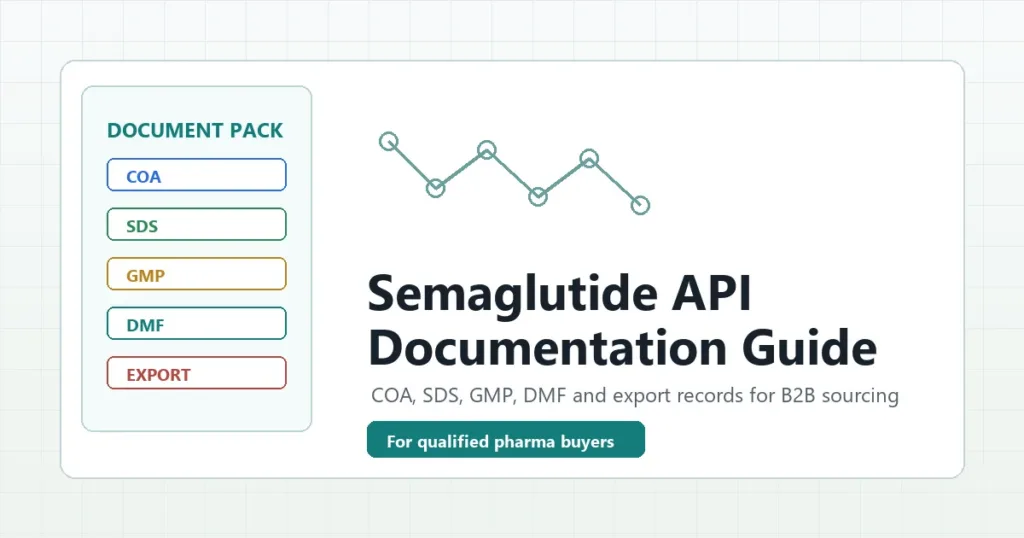
A document-supported Semaglutide API RFQ separates COA, SDS, GMP, DMF and export evidence before supplier comparison.
Semaglutide API documentation can look simple when a supplier lists “COA, SDS, GMP, DMF and export documents” in one line. For a qualified B2B buyer, those records do very different jobs. A COA is batch evidence. SDS/MSDS supports handling and shipment review. GMP evidence points to a quality system and site scope. DMF, ASMF, CEP or LOA support may matter for regulatory files. Export documents help reconcile the commercial shipment with the destination country’s import requirements.
This guide is written for pharmaceutical importers, distributors, API procurement teams, QA/RA reviewers, CDMOs, formulation developers and regulated institutional buyers. It does not provide patient advice, dosage guidance or consumer purchasing information. If your team is already defining a sourcing requirement, Pharmint’s Semaglutide API bulk sourcing page can help you move from document questions to a structured RFQ.
Semaglutide API Documentation: What Buyers Should Confirm First
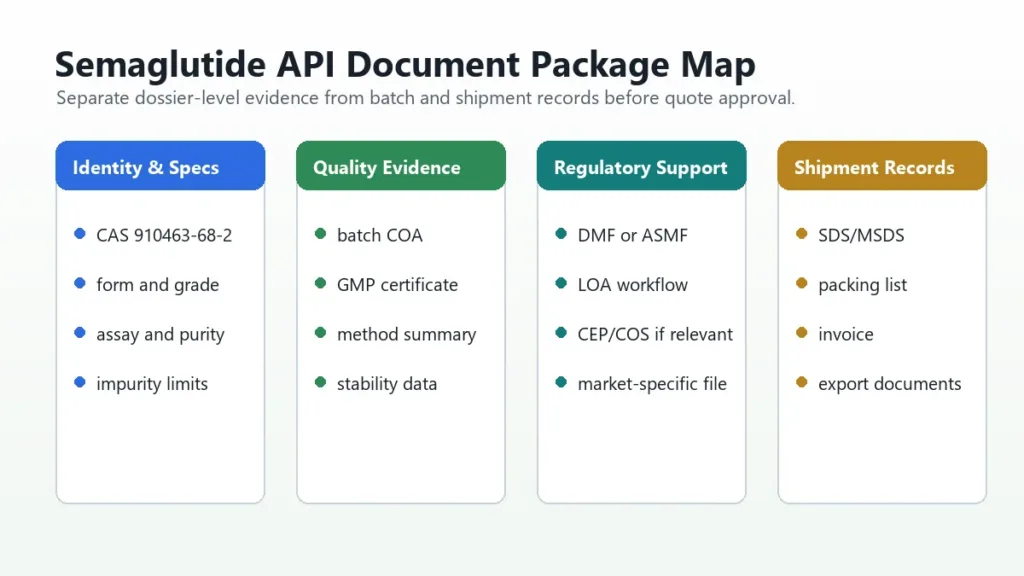
Before asking for a full document packet, confirm the exact material being discussed. Semaglutide API, semaglutide sodium, semaglutide acetate, reference standards, intermediates and finished dosage products are not automatically interchangeable. The buyer should confirm product name, CAS number 910463-68-2, product form, grade, intended use, target quantity, destination country and required specification before comparing supplier documents.
The next step is to identify the document owner. The company sending the quote may be the manufacturer, distributor, exporter, sourcing agent or trading company. The DMF holder, GMP certificate holder and COA issuer may not all be the same legal entity. That is not automatically a problem, but it must be clear enough for QA/RA review.
Use one guiding question: does each document match the same Semaglutide API source, manufacturing site, batch, specification, packaging route and destination-market requirement?
Semaglutide API COA: Batch Evidence Buyers Should Review
A Certificate of Analysis is usually the first document buyers request, but it should not be reviewed in isolation. For Semaglutide API, the COA should be batch-specific and should match the quoted material, not merely a generic sample document.

-
What a Semaglutide API COA Should Include
A useful Semaglutide API COA should include product name, CAS number, batch number, manufacturer or release site, manufacturing date, retest or expiry date, specification limits, actual test results, analytical methods, release approval and document date. Key quality attributes may include identity, assay, purity, peptide-related impurities, residual solvents, water content, appearance, microbial limits where relevant and storage condition.
The COA should also be consistent with the supplier’s specification sheet. If the supplier claims a high assay or purity, the COA should show the method and result. If the specification references internal methods, the buyer may need a method summary, validation statement or laboratory discussion under NDA.
-
Why a COA Does Not Replace Supplier Qualification
A COA is evidence for a batch; it is not complete proof that the supplier is suitable. It does not by itself verify GMP status, regulatory-file access, export feasibility, commercial capacity, cold-chain readiness, change-control expectations or destination-market acceptability.
FDA’s Q7A API GMP guidance includes Certificates of Analysis, stability monitoring, expiry/retest dating and reserve/retention samples in its API quality-system structure. That framing is useful for buyers: a COA should sit inside a wider quality record set, not stand alone as the only approval basis.
Semaglutide API SDS/MSDS: Handling, Storage and Shipment Evidence
SDS or MSDS documentation supports safe handling, storage, transport and emergency-response planning for a pharmaceutical chemical or API. For Semaglutide API procurement, the SDS/MSDS should be checked before shipment planning, warehouse receipt or sample handling.
Buyers should review the product identifier, supplier details, hazard information, handling instructions, storage conditions, transport considerations, exposure controls and disposal guidance. If the SDS/MSDS conflicts with the supplier’s quoted storage condition, packaging or shipping plan, resolve that before payment or shipment.
Pharmint’s broader COA, SDS and regulatory certificate review article is useful for general cross-border document context. This Semaglutide guide goes narrower: it ties those documents to the actual API batch, supplier response and buyer RFQ.
Semaglutide API GMP Documents: Site Scope, Validity and Quality-System Proof
GMP wording is often used loosely in supplier profiles. Buyers should treat it as a claim that needs site-specific evidence. A GMP certificate or inspection-related document should identify the covered legal entity, manufacturing site address, issuing authority or audit body, issue date, validity period and activity scope.
-
Match GMP Evidence to the Manufacturing Site
Ask whether the GMP evidence covers the site that manufactures, tests, releases, packages or stores the quoted Semaglutide API. A certificate for one facility does not automatically support material from another site. A broad company certificate is weaker than evidence tied to the actual API manufacturing and release operation.
The buyer should also compare GMP evidence with the COA issuer, quotation, invoice, packing list and supplier identity. If the names or addresses do not match, ask for a written explanation before shortlisting the source.
-
Connect GMP Claims to Records, Audits and Change Control
GMP status should connect to practical buyer controls: batch release records, deviation handling, complaint handling, change notification, retention samples, method validation, stability monitoring and audit support. Pharmint’s GMP-certified API manufacturer verification guide can support buyers who need a broader GMP supplier-evaluation framework.
For higher-risk or regulated projects, request whether supplier audit summaries, quality agreements or additional quality questionnaires are available under NDA. Do not describe a Semaglutide API supplier as FDA-approved, EU GMP compliant or WHO-GMP certified unless the specific evidence supports that exact wording.
Semaglutide API DMF, ASMF, CEP and LOA: Regulatory Support Documents
DMF, ASMF, CEP, COS and LOA are not interchangeable. Their relevance depends on the destination market, buyer type, regulatory pathway, supplier holder status and intended use. Buyers should ask which regulatory support document exists, who owns it, what site and material it covers, whether it is current and how the buyer can reference or review it.
FDA explains that Drug Master Files provide confidential, detailed information about facilities, processes or articles used in the manufacturing, processing, packaging and storing of human drug products. FDA also states that DMFs are not required by statute or regulation and are neither approved nor disapproved; technical contents are reviewed when an application references the file.

-
Why DMF Support is Not the Same as Approval
If a supplier says “Semaglutide API DMF available” or “USDMF on file,” the buyer should not read that as universal product approval. It may mean a confidential file exists, or that the supplier can support a regulatory reference in a specific pathway. It does not automatically mean the quoted material, shipment, finished product or buyer’s destination-market route is approved.
-
What to Ask Before Relying on a Supplier’s Regulatory File
Ask for the DMF holder, file type, covered site, covered material, filing status, open-part information, Letter of Authorization process and any limits on market use. If the supplier uses a distributor, confirm whether the distributor has authority to discuss the file and support the buyer’s regulatory process.
For country-specific requirements, route the question to the relevant authority or local regulatory adviser.
Semaglutide API Impurity, Stability and Method Documents
Semaglutide is a peptide API, so buyers should look beyond a headline purity number. A supplier response should explain the specification, impurity profile, analytical methods, stability support, storage condition, retest period and packaging configuration.
Impurity documentation may include known impurities, unknown impurities, peptide-related impurities, residual solvents and method references. Stability documentation should support the claimed storage condition and retest or expiry date. FDA Q7A guidance states that a documented, ongoing testing program should monitor API stability characteristics and that results should be used to confirm storage conditions and retest or expiry dates.
For regulated development or manufacturing, QA/RA teams may need additional method validation summaries, chromatograms, reference standard information, change-control statements or CTD/CMC-aligned document organization. The ICH Common Technical Document framework is useful context because it organizes quality, safety and efficacy information into modules, with Module 1 region-specific and Modules 2-5 common.
Export Documents for Semaglutide API Procurement
Export documentation connects the technical file to the commercial shipment. Typical shipment records may include commercial invoice, packing list, COA, SDS/MSDS, country-of-origin statement, end-use declaration, airway bill or bill of lading, temperature or packaging records where relevant, import permit references and destination-specific declarations.
FDA Q7A also highlights traceability expectations for agents, brokers, traders, distributors, repackers and relabelers, including original manufacturer identity, purchase orders, transportation records, authentic Certificates of Analysis and retest or expiry dates. That is directly useful in cross-border Semaglutide API sourcing because the buyer may not be dealing directly with the original manufacturer.
Before shipment, confirm that the invoice, packing list, label, COA and SDS/MSDS all refer to the same product, batch, quantity, pack size, supplier and destination route. Any mismatch should be resolved before customs documents are finalized.
Semaglutide API Documentation Checklist for RFQs
Use this checklist when requesting a Semaglutide API quote:
| Document or Detail | What to Request | Buyer Review Question |
| Product identity | Product name, CAS 910463-68-2, form, grade, specification | Does the offer match the intended API requirement? |
| COA | Batch-specific COA or representative sample COA clearly labeled | Does the COA match the batch, method, site and specification? |
| SDS/MSDS | Current safety document | Are handling, storage and shipment requirements clear? |
| Specification sheet | Assay, purity, impurities, water, residual solvents, microbial limits where relevant | Can suppliers be compared on the same quality basis? |
| GMP evidence | Site-specific certificate, audit or inspection support where available | Does the evidence cover the quoted manufacturing or release site? |
| Regulatory support | DMF, ASMF, CEP/COS, LOA or country-specific file support where relevant | Can the buyer or applicant rely on the file for the intended market? |
| Impurity profile | Known/unknown impurity summary and method references | Is the purity claim technically supported? |
| Stability data | Storage condition, packaging configuration, retest/expiry support | Does the shipment and storage plan fit the data? |
| Export records | Invoice, packing list, country of origin, EUD, shipping records | Can the shipment be reconciled for import and receipt? |
| Quality agreement topics | Change control, deviations, complaints, returns, recalls | Is post-order quality communication defined? |
How Pharmint Helps Buyers Request Document-Supported Quotes
Pharmint helps qualified B2B buyers structure Semaglutide API sourcing requests so suppliers can respond with useful documentation instead of generic price-only replies. A strong inquiry should include buyer type, destination country, intended use, quantity, required specification, required documents, sample needs, timeline, packaging expectations and import constraints.
Pharmint can help buyers request COA/MSDS/SDS availability, compare supplier document packages, identify where GMP or DMF claims need clarification, coordinate document-led quote discussions and route quality inspection support questions where relevant. Pharmint does not replace buyer QA, RA, legal counsel, laboratories or destination-market regulators. Final supplier approval, testing, import eligibility and regulatory use remain the buyer’s responsibility.
If your organization has a defined Semaglutide API requirement, request a document-supported Semaglutide API quote through Pharmint. Include the destination market, quantity, intended use, document checklist and any QA/RA constraints so supplier options can be reviewed on evidence, not only price.
Semaglutide API Documentation FAQs
What documents are needed to source Semaglutide API?
Qualified B2B buyers commonly request a batch COA, SDS/MSDS, specification sheet, GMP evidence, impurity profile, stability data, DMF/ASMF/CEP or LOA support where relevant, invoice, packing list, export documents and end-use declaration if required.
Is a Semaglutide API COA enough to approve a supplier?
No. A COA is important batch evidence, but it should be reviewed with supplier identity, manufacturing-site evidence, GMP documentation, specification, impurity data, stability support, regulatory-file access, sample testing and shipment records.
What does Semaglutide API DMF support mean?
DMF support may mean that confidential information about facilities, processes or materials can support a regulatory application through an authorized reference. It is not the same as product approval, supplier approval or import approval.
How should buyers verify Semaglutide API GMP documents?
Check the legal entity, site address, issuer, issue date, validity, covered activity and scope. Then compare the GMP evidence with the quoted manufacturer, COA issuer, batch record and intended destination market.
Can Pharmint provide Semaglutide API COA/MSDS support?
Pharmint can help qualified B2B buyers request supplier options where COA/MSDS/SDS and other document support may be available, depending on supplier qualification, batch status, destination market and buyer requirements.