

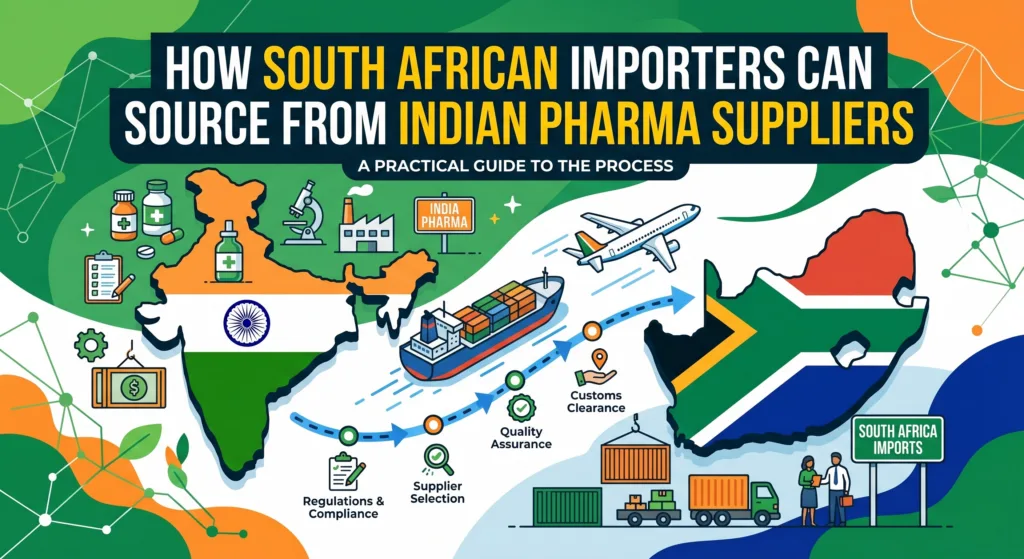
Have you ever wondered which Indian pharma suppliers are most relevant for South African importers, and how buyers should verify them before requesting a quote?
India is one of the world’s most important pharmaceutical sourcing markets. The country ranks third globally by pharmaceutical volume and supplies around 20% of global generic medicines. In FY 2024–25, India’s drugs and pharmaceutical exports reached about US$30.4–30.47 billion, representing roughly 9.4% year‑on‑year growth from around US$27.8 billion in FY 2023–24 [source]. India also exports drugs and pharmaceuticals to more than 200 countries, making it a key sourcing base for South African buyers, comparing APIs, finished formulations, generic medicines, intermediates, and bulk drug substances.
For buyers researching Top Indian Pharma Suppliers for South Africa, the main question is not only which companies export from India. It is whether those suppliers can provide the right product category, GMP-aligned documentation, batch-level quality records, export experience, lead times, and SAHPRA-ready import support.
South Africa’s healthcare market also requires careful compliance planning because healthcare-related products must be registered and evaluated by SAHPRA, and entities involved in manufacture, distribution, import, or export must be licensed.
Pharmint helps B2B buyers move from open-ended supplier research to structured supplier discovery for APIs, pharma raw materials, API intermediates, and documentation-focused sourcing. Buyers can compare supplier options and submit a quote request with clearer product and compliance expectations.
The answer is simple: the best Indian pharma supplier for South Africa is not always the largest exporter. It is the supplier whose product scope, quality documents, regulatory readiness, commercial terms, and import pathway match the buyer’s sourcing requirements.
Quick Answer: Which Indian Pharma Suppliers are Relevant for South Africa?
The most relevant Indian pharma suppliers for South Africa include large generic medicine manufacturers, API and bulk drug substance suppliers, finished formulation exporters, pharma intermediate suppliers, and contract manufacturing partners.
Indian-headquartered companies commonly researched in this market include Cipla, Sun Pharma, Dr. Reddy’s Laboratories, Lupin, Aurobindo Pharma, Zydus Lifesciences, Torrent Pharma, Alkem, Glenmark, and Mankind Pharma.
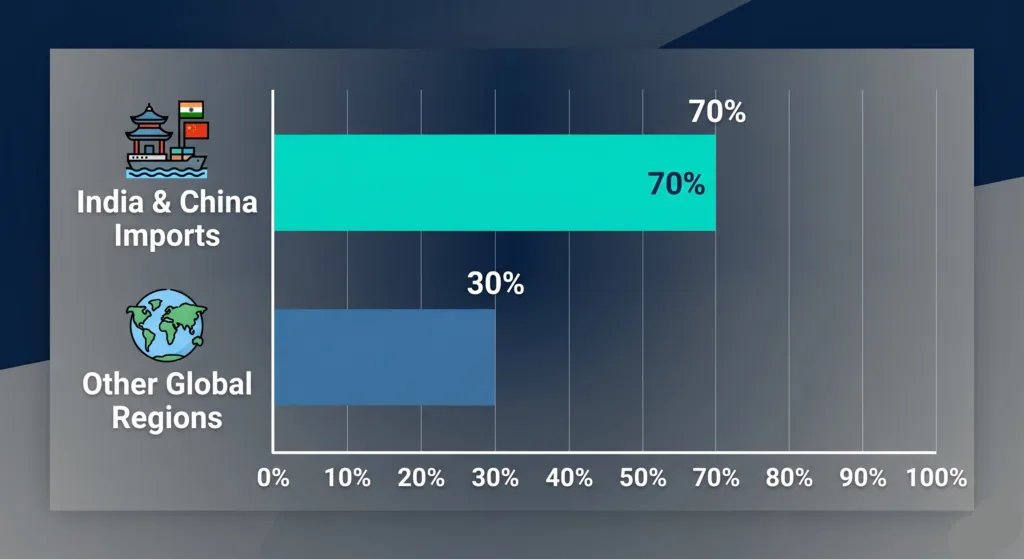
For South African importers, the right supplier is not always the biggest name. The better shortlist is built around product category, GMP status, COA availability, batch documentation, dossier readiness, export experience, MOQ, lead time, and SAHPRA-related import requirements. According to the International Trade Administration, the majority of APIs used in South Africa are imported from India and China, and these APIs may account for up to 70% of pharmaceuticals sold in the country.
For buyers who need supplier options beyond public company names, Pharmint helps South African importers compare verified Indian pharma suppliers by product category, documentation readiness, MOQ, lead time, and quote requirements. Buyers can use Pharmint to explore API sourcing, API intermediates, pharma raw materials, and submit a quote request for matched supplier options.
Indian Supplier Types at a Glance
| Supplier Type | Best Fit for South African Buyers | What to Verify Before Inquiry |
| Generic medicine manufacturers | Chronic care, anti-infectives, retail medicines, and hospital-use medicines | Product availability, pack format, registration pathway, and local distribution route |
| API and bulk drug substance suppliers | Formulators, manufacturers, R&D teams, and procurement departments | GMP status, COA, impurity profile, batch records, and supply consistency |
| Finished formulation exporters | Tablets, capsules, injectables, OTC products, and specialty products | Product dossier, stability data, labeling requirements, and export history |
| Pharma intermediate and raw material suppliers | Manufacturing inputs, custom sourcing, and formulation support | Specification match, SDS/MSDS, grade, purity, and intended-use documentation |
| Contract manufacturing partners | Private label, tender support, and scalable production needs | Manufacturing scope, regulatory experience, capacity, lead time, and quality agreements |
Why South African Buyers Source Pharma Products from India?
South African buyers source pharma products from India because the India–South Africa sourcing relationship fits several practical procurement needs, like:
- Broad product availability,
- Competitive manufacturing capacity,
- Experience with regulated markets, and
- Flexible supplier categories for both finished products and manufacturing inputs.
For importers, wholesalers, distributors, and procurement teams, India offers access to generic medicines, bulk drugs, over-the-counter products, vaccines, biosimilars, biologics, and formulation support from a diversified pharmaceutical manufacturing base.
South Africa is also a high-value destination within the African pharmaceutical landscape. The International Trade Administration describes South Africa as the largest pharmaceutical market in Sub-Saharan Africa.
Its market includes both innovator medicines and generics, but public-sector purchasing is strongly influenced by price, access, and supply reliability. That makes Indian pharma suppliers relevant for buyers seeking cost-effective sourcing without ignoring quality, registration, and documentation requirements.
India’s strength is not limited to finished medicines. The country’s pharmaceutical base includes generic drugs, bulk drugs, over-the-counter drugs, vaccines, biosimilars, and biologics, which allows South African buyers to source across different procurement models.
A distributor may need finished formulations for retail channels, while a local manufacturer may need APIs, bulk drug substances, pharma intermediates, or raw materials for production planning.
This is why supplier selection should start with the buyer’s sourcing objective. A company importing finished medicines will need a different partner than a manufacturer sourcing an API or a procurement team exploring contract manufacturing.
The right supplier is the one that fits the product category, documentation package, quantity requirement, and South African market route.
Main Indian Pharma Supplier Types for South Africa
There are a total of 6 different types of Indian pharma suppliers for South Africa:
-
Generic Medicine and Finished Formulation Exporters
This supplier type is best suited for buyers sourcing tablets, capsules, injectables, OTC products, hospital-use medicines, and chronic therapy products. These exporters are usually relevant when the buyer needs finished pharmaceutical products for distribution, tender participation, or retail channels.
For this route, buyers should check whether the exporter can support product dossiers, pack formats, stability data, labeling expectations, and market-specific documentation before discussing price.
-
API and Bulk Drug Substance Suppliers
API suppliers are relevant for South African manufacturers, formulators, R&D teams, and procurement departments that need active ingredients for production or development. India’s pharmaceutical industry includes APIs and bulk drugs as part of its broader manufacturing base, along with generics, OTC medicines, vaccines, biosimilars, biologics, and contract research and manufacturing. (Source)
For API sourcing, buyers should compare specifications, impurity profile, batch consistency, COA availability, and intended-use documentation. This supplier type is especially important when product quality, supply continuity, and batch-level traceability affect downstream manufacturing decisions.
Buyers can explore Pharmint’sAPI sourcing category and related glossary resource onbulk drug substances to understand how these materials fit into pharmaceutical procurement.
-
Pharma Intermediate and Raw Material Suppliers
Pharma intermediate and raw material suppliers are important for manufacturers that need input materials before final API or formulation production. These materials require careful specification matching because differences in grade, purity, route of synthesis, or intended use can affect manufacturing outcomes.
South African buyers should verify the material specification, SDS/MSDS availability, purity profile, storage needs, packaging format, and intended-use documentation before shortlisting a supplier.
-
Contract Manufacturers and Private Label Suppliers
Contract manufacturers are useful when a South African buyer needs production support instead of a one-time product purchase. This may include private-label formulations, custom dosage forms, scale-up support, or repeat manufacturing for specific product lines.
Before choosing this route, buyers should clarify manufacturing scope, batch size, lead time, quality agreement, regulatory experience, and whether the supplier operates as a manufacturer, exporter, trading company, CMO, or CDMO.
-
B2B Pharma Sourcing Platforms for Supplier Shortlisting
A B2B pharma sourcing platform is useful when buyers need to compare multiple supplier options instead of relying on a single company website or public supplier list. For South African importers, this can help narrow the search by product category, documentation readiness, MOQ, lead time, supplier capability, and quote requirements.
Pharmint supports this step by helping buyers explore verified supplier options for APIs, finished formulations, pharma intermediates, raw materials, and other B2B pharmaceutical sourcing needs.
Buyers can start with a quote request when they need matched supplier options based on product specifications and sourcing requirements.
How South African Importers Should Evaluate Indian Pharma Suppliers?
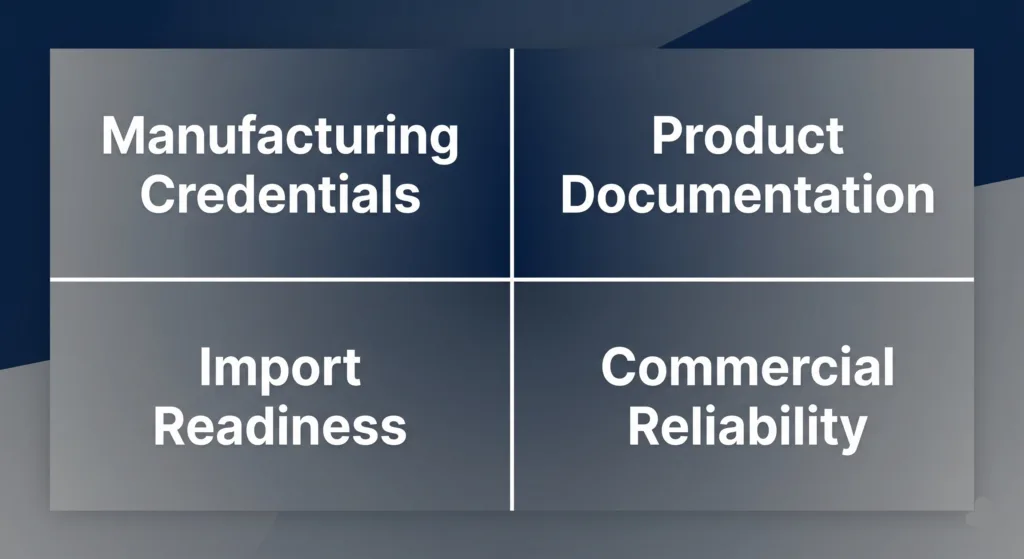
Before choosing an Indian pharma supplier, South African importers should check four things first:
- Manufacturing credibility,
- Product documentation,
- South Africa’s import readiness, and
- Commercial reliability.
A supplier may look suitable online, but procurement teams need evidence that the product, facility, documents, and shipment process can support a regulated B2B transaction.
Manufacturing Credentials and GMP Scope
Start by checking whether the supplier’s manufacturing site, product scope, and quality system match the product being sourced. A Good Manufacturing Practice claim should not be treated as proof by itself. Buyers should confirm the certificate holder, issuing authority, site address, product category, expiry date, and whether the certificate covers the requested dosage form, API, intermediate, or raw material.
For quality context, the FDA explains that current good manufacturing practice regulations contain minimum requirements for the methods, facilities, and controls used in manufacturing, processing, and packing of a drug product. Buyers can also review Pharmint’s glossary on current good manufacturing practice for terminology clarity.
Quality Documents and Batch-Level Records
Documentation should be reviewed before price negotiation. For APIs, intermediates, and raw materials, buyers should request a Certificate of Analysis, SDS, MSDS, product specification, batch number, storage conditions, and end-use declaration where required.
For API-related sourcing, FDA’s Q7 guidance says authentic certificates of analysis should be issued for each batch of intermediate or API on request, and the certificate should include details such as batch number, release date, tests performed, acceptance limits, and numerical results where applicable. This makes batch-level documentation a practical screening point, not just an administrative formality. Buyers sourcing APIs should also review the product’s impurity profile and specification alignment before shortlisting a supplier.
SAHPRA and Import-Readiness Requirements
South African buyers should confirm whether the product category, importer role, and local market route require registration, licensing, or an authorized local representative. The International Trade Administration states that all healthcare-related products must be registered with and evaluated by SAHPRA, and entities involved in the manufacture, distribution, import, or export of healthcare products must be licensed by SAHPRA.
This check should happen early. If the supplier cannot support the required product documents, labeling details, pack information, or regulatory files, the buyer may face delays even if the product price is attractive. For technical documentation, buyers can also review ICH Guidelines to understand how international quality expectations may affect pharmaceutical sourcing.
Export Capability, MOQ, Lead Time, and Logistics
A supplier’s export experience matters because pharma sourcing involves more than product availability. Buyers should ask whether the supplier has previously exported similar products, whether they can provide the required shipping documents, and whether they understand packaging, storage, temperature control, and delivery timelines.
Commercial checks should include minimum order quantity, sample availability, production lead time, payment terms, Incoterms, shelf-life at dispatch, and communication responsiveness. These details help South African importers compare suppliers on execution risk, not only unit price.
Pharmint Supplier Verification Checklist for South African Buyers
After a buyer understands what to check, the next step is to organize the sourcing request so supplier comparison becomes easier. Pharmint’s checklist helps South African buyers move from scattered supplier research to a clear, quote-ready requirement.
Step 1: Define the Product Requirement Clearly
Start with the exact product name, dosage form, or material grade, CAS number if applicable, target quantity, destination country, and expected use case. A clear requirement helps suppliers respond with relevant availability, pricing, lead time, and documentation support.
For ingredient-based sourcing, buyers can define whether they need an active pharmaceutical ingredient, bulk drug substance, pharmaceutical intermediate, or raw material.
Step 2: Choose the Right Supplier Category
Not every Indian pharma supplier serves the same purpose. A buyer looking for finished formulations should not evaluate suppliers the same way as a manufacturer sourcing APIs or intermediates.
Pharmint helps buyers narrow supplier options by sourcing category, including APIs, API intermediates, raw materials, finished formulations, and contract manufacturing support.
Step 3: Prepare a Quote-Ready Inquiry
A strong inquiry should include the product requirement, target quantity, preferred documentation, delivery expectations, and any special handling needs. This reduces back-and-forth and helps suppliers respond with more accurate commercial information.
Buyers should also mention whether they need samples, bulk supply, recurring procurement, custom sourcing, or documentation review before commercial discussion.
Step 4: Compare Supplier Responses Beyond Price
Once responses are received, buyers should compare suppliers by product match, document readiness, communication quality, lead time, MOQ, and ability to support the South African sourcing route. The lowest price is not always the lowest-risk option.
This step helps procurement teams identify which supplier is most suitable for the actual sourcing requirement, not just which supplier appears first in search results.
Step 5: Add Buyer Details That Improve Supplier Matching
A sourcing request should not stop at product name and quantity. South African buyers should also include the preferred grade, dosage form, pack size, destination port or city, target delivery window, documentation expectations, and whether the requirement is for sample evaluation, bulk supply, repeat procurement, or custom sourcing.
This gives suppliers enough context to respond with relevant availability, realistic lead time, applicable commercial terms, and document support. It also helps filter out suppliers that cannot match the buyer’s product scope or import pathway before commercial discussions begin.
Indian Exporters vs South African Distributors: Which Route Fits?
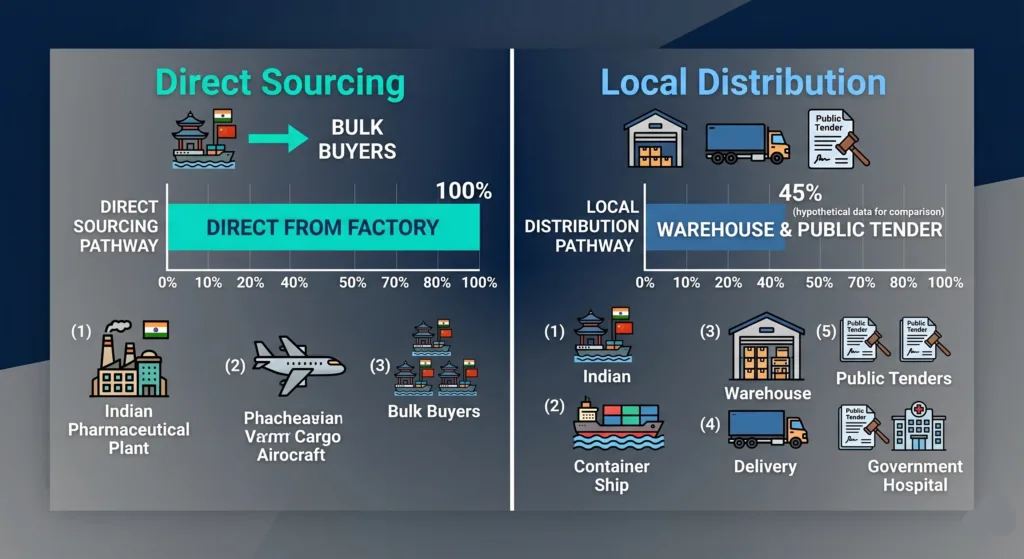
South African buyers often need to choose between direct sourcing from Indian exporters and working through local South African distributors. The right route depends on the buyer’s import capability, product category, order volume, regulatory pathway, and market access needs.
Direct sourcing is usually better suited for importers, manufacturers, and bulk buyers, while local distributors are more useful for in-country distribution, tenders, customer relationships, warehousing, and post-import coordination.
When Direct Sourcing from Indian Exporters Works Best
Direct sourcing is usually more relevant when the buyer has import capability, knows the product requirement clearly, and needs larger-volume procurement.
This route can suit buyers sourcing APIs, bulk materials, finished formulations, or repeat supply from Indian manufacturers and exporters.
It can also help buyers communicate earlier with the source supplier about availability, production timelines, pack format, and commercial terms.
However, direct sourcing works best when the South African buyer already understands the local import route and has the right in-country responsibilities covered.
When a South African Distributor is Needed
A local distributor can be important when the buyer needs in-market access, tender participation, warehousing, local sales channels, or customer delivery inside South Africa.
For public-sector opportunities, the International Trade Administration notes that South Africa’s eTender Publications Portal displays public sector tenders, and overseas firms are generally expected to work through an agent in South Africa when selling to government agencies.
This makes the local distributor role different from the Indian exporter role. The exporter may supply the product, while the South African distributor may support local market entry, tender access, payment flow, customer relationships, and delivery coordination.
Why Many Pharma Buyers Use Both Routes
Many South African pharma sourcing models use both sides of the supply chain: An Indian exporter for product supply and a South African importer or distributor for local execution. This is common when the buyer needs international product access but also requires local presence, buyer relationships, or in-market handling.
For Pharmint readers, the practical question is not “exporter or distributor?” It is “which combination supports the sourcing goal?” A manufacturer sourcing an input material may prioritize direct exporter access, while a company serving retail, hospital, or public-sector channels may need a local South African partner as part of the route to market.
Buyers researching regional trade partners can also review Pharmint’s guide to top African pharma importers to understand how importer and distributor roles differ across African pharmaceutical markets.
How Pharmint Helps South African Buyers Build a Supplier Shortlist?
Pharmint helps South African buyers turn supplier research into a more organized shortlist. Instead of collecting company names from search results, buyers can evaluate Indian pharma suppliers around the actual sourcing need: product fit, supplier role, quantity range, destination market, and response quality.
Compare Indian Pharma Suppliers by Sourcing Fit
Public search results often mix manufacturers, exporters, traders, distributors, and sourcing agents in the same list. Pharmint helps buyers separate those options so they are not comparing unrelated supplier types.
This is useful for South African importers who need a practical shortlist rather than a broad directory of Indian pharmaceutical companies.
Support for Multi-Product and Repeat Procurement
Many pharma buyers do not source only one product once. They may need recurring API supply, multiple formulation categories, intermediate sourcing, or raw material support for future production cycles.
Pharmint can support this kind of buyer journey by helping procurement teams organize sourcing needs acrossAPIs, API intermediates , pharma raw materials, and other B2B pharmaceutical categories.
Move from Research to Supplier Conversation
A buyer may know the product they need but still struggle to identify which supplier is worth contacting first. Pharmint helps reduce that gap by making the sourcing request more specific before supplier communication begins.
This gives South African buyers a clearer starting point for commercial discussions, especially when the requirement involves bulk supply, recurring procurement, custom sourcing, or documentation-sensitive categories.
When South African Buyers Should Use Pharmint?
Pharmint is most useful when a buyer needs more than a company list. It is relevant when the buyer wants to compare supplier options, source across multiple pharma categories, or prepare a more complete inquiry before engaging Indian exporters.
South African buyers can start by submitting a focused quote request with the product name, quantity range, destination, and key sourcing expectations.
FAQs About Indian Pharma Suppliers for South Africa
What documents are usually needed to import pharma products into South Africa?
South African importers usually need supplier invoices, packing lists, product specifications, COA, SDS/MSDS, batch details, and applicable SAHPRA-related documents. The exact document set depends on product type, importer role, and regulatory pathway.
Can a South African buyer import medicines directly from India?
A South African buyer can import medicines from India only when the product, importer, and route meet applicable South African regulatory and licensing requirements. Buyers should confirm SAHPRA obligations before placing orders.
Are Indian pharma suppliers allowed to export APIs to South Africa?
Indian API suppliers can export to South Africa when they meet export requirements, and the South African buyer can support the required import route. The buyer should verify API quality documents, batch data, specifications, and intended-use details.
Does every Indian pharma supplier need SAHPRA approval?
Not every Indian supplier needs direct SAHPRA approval, but products entering South Africa may require registration, evaluation, or licensing through the correct local pathway. Buyers should confirm responsibility before sourcing.
What is the difference between an Indian pharma exporter and a manufacturer?
A manufacturer produces the pharmaceutical product or ingredient, while an exporter manages international sales and shipments. Some companies do both. Buyers should confirm who controls production, quality records, and batch documentation.
How can South African buyers avoid fake pharma suppliers?
South African buyers can reduce supplier risk by verifying company identity, factory details, certificates, batch documents, product specifications, export history, and pricing consistency. Unclear documents or unrealistic prices are warning signs.
What pharma products are commonly sourced from India for South Africa?
South African buyers often source generic medicines, APIs, bulk drug substances, finished formulations, intermediates, raw materials, OTC products, and specialty pharmaceutical inputs from Indian suppliers, depending on procurement needs.
Should South African buyers ask for samples before bulk pharma orders?
Yes. Samples can help buyers evaluate product specifications, documentation quality, packaging, supplier responsiveness, and suitability before bulk procurement. Sample handling should still follow applicable import and regulatory requirements.
How long does pharma sourcing from India to South Africa usually take?
Timelines vary by product type, documentation readiness, manufacturing availability, shipping method, and import requirements. Ready-stock products may move faster, while custom, regulated, or documentation-heavy products need longer planning.
Can Pharmint help compare Indian pharma suppliers for South Africa?
Yes. Pharmint helps South African buyers compare Indian pharma suppliers by product category, sourcing requirement, documentation readiness, supplier role, and quote expectations for APIs, formulations, intermediates, and raw materials.

