

A pharmaceutical RFQ template should do more than ask for product name, quantity and price. A useful request for quotation gives suppliers the commercial, quality, regulatory and shipment context they need to return comparable responses. That is especially important when the same buyer may source both active pharmaceutical ingredients and finished dosage forms.
This guide gives procurement, QA, regulatory affairs, CDMO, importer, distributor and institutional buying teams a shared RFQ structure. Use the shared core for every request, then add the API branch or finished dosage branch depending on the product route. This article is for qualified B2B sourcing only and does not provide patient advice, dosage guidance or consumer purchasing support.
When your requirement is ready, submit it through Pharmint’s request a structured pharmaceutical quote workflow so supplier responses can be reviewed against the same scope.
Quick Answer: What Should a Pharmaceutical RFQ Include?
A pharmaceutical RFQ should include buyer identity, destination market, intended B2B use, product route, product specification, quantity tiers, document requirements, packaging needs, shipment basis, Incoterms, payment terms, timeline and supplier-response format.
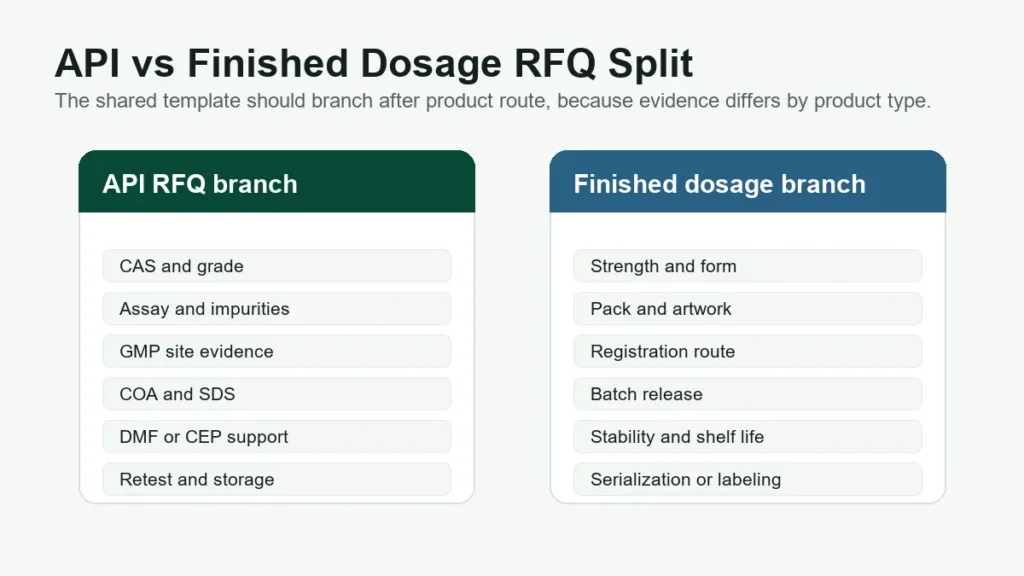
For an API RFQ, add CAS number where applicable, grade, assay, impurity profile, batch-specific COA, SDS or MSDS, GMP evidence, DMF, CEP or ASMF support where relevant, retest period, storage conditions and original manufacturer identity.
For a finished dosage RFQ, add strength, dosage form, pack configuration, label and artwork requirements, registration or approval route, batch release evidence, stability data, remaining shelf life, serialization or traceability where applicable, and destination-market import documents.
Why API and Finished Dosage RFQs Need a Shared Core and Separate Branches
APIs and finished dosage forms sit at different points in the pharmaceutical supply chain. An active pharmaceutical ingredient is evaluated as a drug substance or raw material for formulation, development, manufacturing or analytical use. A finished dosage form is evaluated as a market-ready medicine such as a tablet, capsule, injection, cream, gel, suspension or other finished pharmaceutical product.
The shared RFQ core keeps commercial comparison consistent. The branch fields prevent technical mismatch. Without this split, suppliers may quote on different assumptions: one supplier may quote an API grade with limited documents, another may quote a finished tablet pack, and a third may quote a private-label route that requires new artwork or registration work.
Shared Pharmaceutical RFQ Template Fields
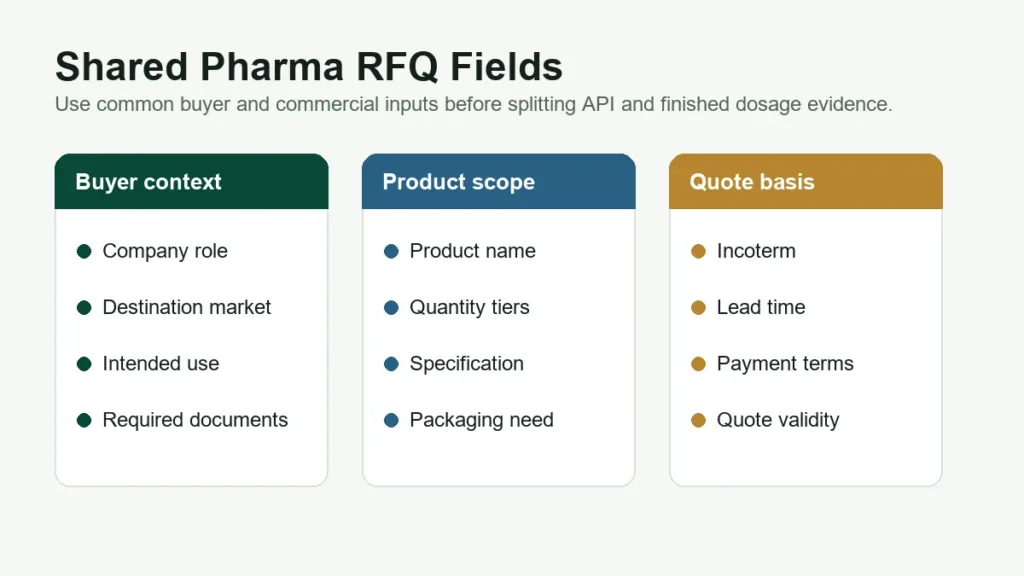
Use these fields for every pharma supplier quote request before adding API-specific or finished-product-specific requirements.
Buyer, Destination and Intended Use
- Buyer company name, country, website and corporate contact details.
- Buyer role: manufacturer, CDMO, CRO, importer, distributor, wholesaler, tender buyer, institutional buyer or sourcing agent.
- Destination market and consignee country.
- Intended B2B use: formulation, development, analytical testing, commercial manufacturing, distribution, tender supply, private label or registration project.
- Required buyer qualifications, license details or end-use declaration where applicable.
Quantity, Timeline and Commercial Terms
- Sample quantity, first order quantity, annual forecast and repeat-order plan.
- Target dispatch date, target arrival date and internal review deadline.
- Preferred Incoterm, destination port or delivery point, currency and payment preference.
- Required quote validity period and supplier-response deadline.
- Inspection, sample, rejection, replacement and complaint expectations.
Supplier Response Format
Ask every supplier to respond in the same format: product route, manufacturer identity, offered quantity, MOQ, unit price, lead time, document package, packaging, shipment basis, payment terms, exclusions and assumptions. This makes quote comparison possible without rewriting each supplier response manually.
API RFQ Template Fields
For API sourcing, the RFQ should prove that the supplier understands the exact material and the buyer’s technical and regulatory document needs. Pharmint’s bulk APIs and pharmaceutical raw materials category can support discovery, but the RFQ should narrow the request to a precise material before price comparison.
For molecule-specific examples, buyers can review Pharmint’s Semaglutide API sourcing page and Tadalafil API sourcing page. Those pages show the type of product identity, CAS, quantity, destination, document and quote inputs that an API RFQ should capture before supplier comparison.
API Identity, Grade and Specification
- API name and CAS number where applicable.
- Salt, base, hydrate, polymorph, particle size or sterile grade where relevant.
- Pharmacopeial reference or in-house specification.
- Assay, purity, impurity limits, residual solvents, water content and microbial requirements where relevant.
- Reference standard, method or specification expectations.
API Quality, GMP and Regulatory Documents
Request a document package before comparing price. For APIs, the first document set usually includes batch-specific COA, SDS or MSDS, specification sheet, GMP evidence, impurity profile, residual-solvent data, stability or retest information, packaging details and export documents. Where relevant, ask whether DMF, CEP, ASMF or Letter of Authorization support is available.
FDA’s Q7A API GMP guidance says API distributors and related parties should maintain complete traceability records, including original manufacturer identity and authentic Certificates of Analysis. That is why an API RFQ should ask who manufactured the material, which site is involved, and whether the COA chain can be reconciled to the quoted batch.
WHO’s API prequalification page also distinguishes API prequalification from the API master file procedure and explains that API prequalification includes assessment of the API master file and verification of manufacturing-site GMP compliance. Buyers should use this as a reminder to separate document availability from final supplier approval.
API Packaging, Storage and Retest Requirements
- Pack size and container type, such as vial, bottle, foil bag, fiber drum or HDPE drum.
- Closure system, liner, seal and tamper-evidence requirements.
- Storage conditions and transport temperature requirements based on supplier documents.
- Manufacturing date, retest date, expiry date or remaining retest period.
- Sample chain of custody and testing plan.
Finished Dosage RFQ Template Fields
Finished dosage RFQs need product, pack, label, registration and distribution evidence. A finished product quote is not comparable to an API quote because the buyer is evaluating a ready-to-supply pharmaceutical product, not only a material for further manufacture.
Strength, Dosage Form and Pack Configuration
- Product name, active ingredient or ingredients, strength and dosage form.
- Route of administration and release profile where relevant.
- Primary pack: blister, bottle, ampoule, vial, tube, sachet or other format.
- Secondary carton, leaflet, shipper configuration and units per case.
- Private-label, branded, generic or tender pack requirement.
For broad finished-dose discovery, Pharmint’s bulk pharmaceutical formulations category and tablet product category can help buyers identify product routes before preparing the RFQ. Buyers preparing a finished-tablet request can also review Pharmint’s Tadalafil 20 mg tablets product page as an example of finished dosage RFQ fields such as strength, pack, quantity, destination, documentation and distribution-readiness checks.
Registration, Labeling and Batch Evidence
Finished dosage RFQs should ask for the market route: approved product, registered product, pending registration, private-label project, export-only supply, tender supply or local distributor route. For U.S.-bound prescription drugs, FDA states that imported prescription drugs must meet general requirements including foreign establishment registration, drug listing, drug approval, labeling and CGMP conformance. Other countries have their own import and registration requirements.
Request product registration or approval evidence where applicable, manufacturer identity, marketing authorization holder or applicant details, label and artwork, batch COA, stability data, manufacturing date, expiry date, remaining shelf life, serialization or traceability details where required, and pharmacovigilance or complaint handling route where relevant.
Finished Product Logistics and Shelf Life
- Minimum remaining shelf life at dispatch and arrival.
- Storage and transport conditions for the finished product and pack.
- Country of origin, certificate of origin and export-document support.
- Temperature control, humidity protection or light protection where specified.
- Invoice, packing list, transport document and import-permit assumptions.
Supplier Quote Comparison Template
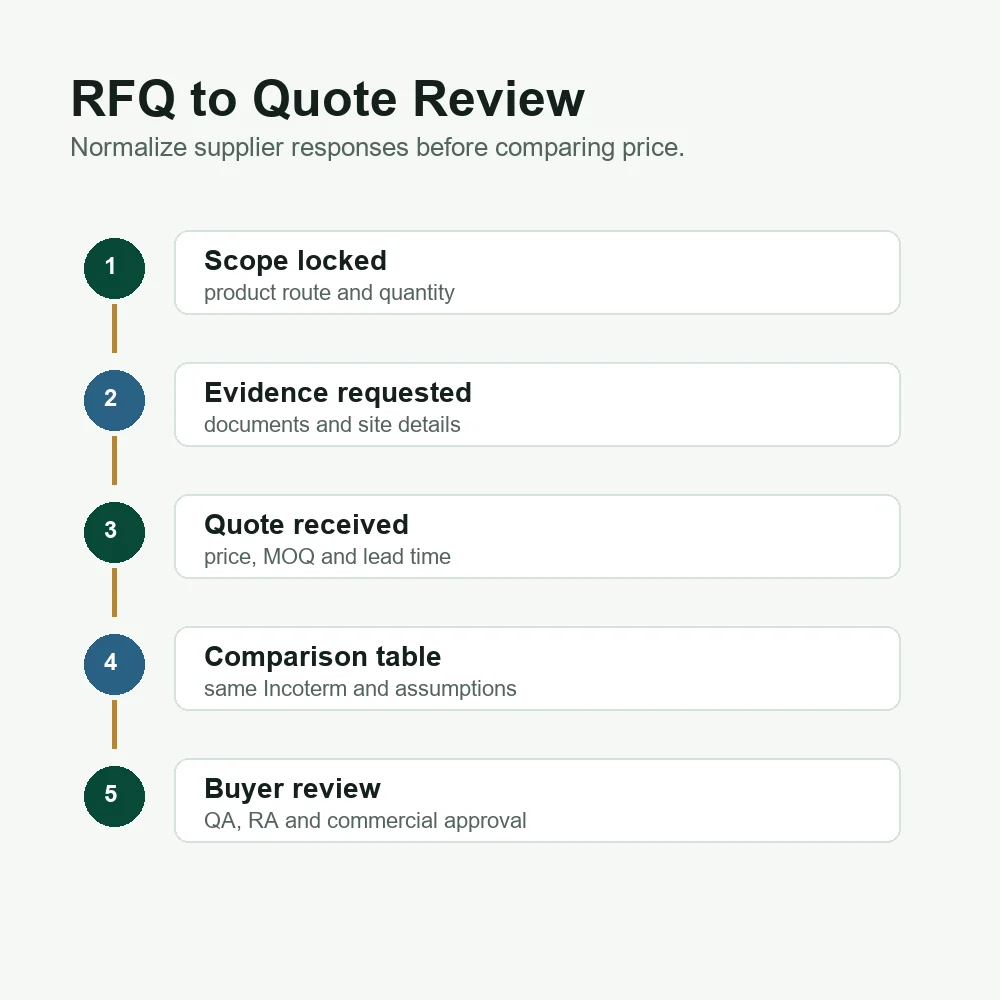
Once suppliers respond, normalize the quotes before selecting a shortlist. Do not compare a low EXW price against a CIF or DDP offer as if they are equivalent. Do not compare a quote with full documentation against one that excludes batch, quality or registration evidence.
| Comparison Field | What to Check | Why It Matters |
| Product route | API, finished dosage, private-label project or registration route. | Different routes require different evidence and timelines. |
| Specification match | API grade or finished dosage strength, form and pack. | Prevents comparing unlike products. |
| Document package | COA, SDS/MSDS, GMP evidence, DMF/CEP support, stability, registration and export documents as relevant. | Shows whether the offer can support QA/RA and import review. |
| MOQ and quantity tier | Sample, pilot, first order and annual forecast assumptions. | Unit price can change sharply by volume and forecast commitment. |
| Lead time | Stock status, production time, QC release, document preparation and freight booking. | Separates available stock from made-to-order or uncertain supply. |
| Incoterm and logistics | EXW, FOB, CIF, DAP, DDP, destination point, freight and insurance assumptions. | Determines landed cost and buyer responsibility. |
| Risk controls | Sample review, quality inspection, complaint route, rejection terms and change notification. | Reduces post-PO surprises. |
Pharmint’s cost-estimator content can help buyers think through MOQ, timeline and cost assumptions before requesting a formal supplier quote.
Common RFQ Mistakes That Delay Supplier Quotes
- Asking for “best price” without quantity, destination, product route or required documents.
- Mixing API, intermediate, reference standard and finished dosage language in one unclear request.
- Not stating buyer type or intended B2B use.
- Requesting GMP, DMF or CEP without identifying destination-market relevance.
- Ignoring pack configuration, label language, artwork and remaining shelf life for finished dosage forms.
- Comparing quotes with different Incoterms, payment assumptions or freight responsibility.
- Waiting until after price approval to ask for COA, SDS, GMP evidence or registration support.
How Pharmint Helps Buyers Submit Better RFQs
Pharmint helps qualified B2B buyers move from vague supplier searches to structured sourcing requests. A buyer can define the product route, exact product requirement, quantity, destination market, document package, packaging needs, timeline and commercial terms before supplier responses are compared.
Pharmint should be positioned as a sourcing and RFQ coordination layer, not as a replacement for buyer-side QA, RA, legal, customs or regulatory review. Final supplier qualification, import clearance, product registration, batch release and end-use approval remain the buyer’s responsibility.
API and Finished Dosage RFQ FAQs
What is a pharmaceutical RFQ template?
A pharmaceutical RFQ template is a structured request form that tells suppliers what product, quantity, documents, quality evidence, packaging, shipment terms and commercial assumptions they should quote against.
How is an API RFQ different from a finished dosage RFQ?
An API RFQ focuses on drug substance identity, grade, assay, impurity profile, COA, SDS, GMP evidence, retest period, storage and regulatory-document support. A finished dosage RFQ focuses on strength, dosage form, pack, label, registration route, batch release, stability, remaining shelf life and distribution evidence.
Should buyers ask for COA and SDS before price comparison?
Yes. Buyers should request document availability before price approval because a low quote may be unsuitable if it cannot support batch review, handling, storage, import or regulatory checks.
Can one RFQ template cover both APIs and finished dosage forms?
Yes, if the template uses a shared core and separate branches. Buyer identity, quantity, destination, Incoterms and timeline can be shared. API evidence and finished dosage evidence should be handled separately.
What should suppliers return in response to a pharma RFQ?
Suppliers should return product route, manufacturer identity, specification match, MOQ, quantity tier, unit price, lead time, document package, packaging, Incoterm, payment terms, quote validity and exclusions or assumptions.
Can Pharmint prepare supplier quotes from this RFQ?
Pharmint can help qualified buyers submit structured sourcing requirements and compare supplier responses. Final acceptance of supplier, product, document, import and end-use requirements remains with the buyer’s qualified teams.
Request a Structured Pharmaceutical Quote Through Pharmint
If your team is ready to compare API or finished dosage supplier options, prepare the RFQ before asking for the lowest price. Include product route, product identity, quantity, destination market, document requirements, packaging, Incoterm, lead-time target and buyer qualification details.
For product-specific next steps, start with the relevant Pharmint page: Semaglutide API, Tadalafil API or Tadalafil 20 mg tablets.
Request a structured pharmaceutical quote through Pharmint so supplier responses can be reviewed by product scope, document evidence, MOQ, lead time, Incoterm and destination-market fit.
Compliance note: This article is for qualified B2B sourcing and procurement education only. It does not provide medical advice, treatment claims, dosage guidance, consumer purchase support, regulatory approval confirmation, import approval or supplier certification guarantees.

