

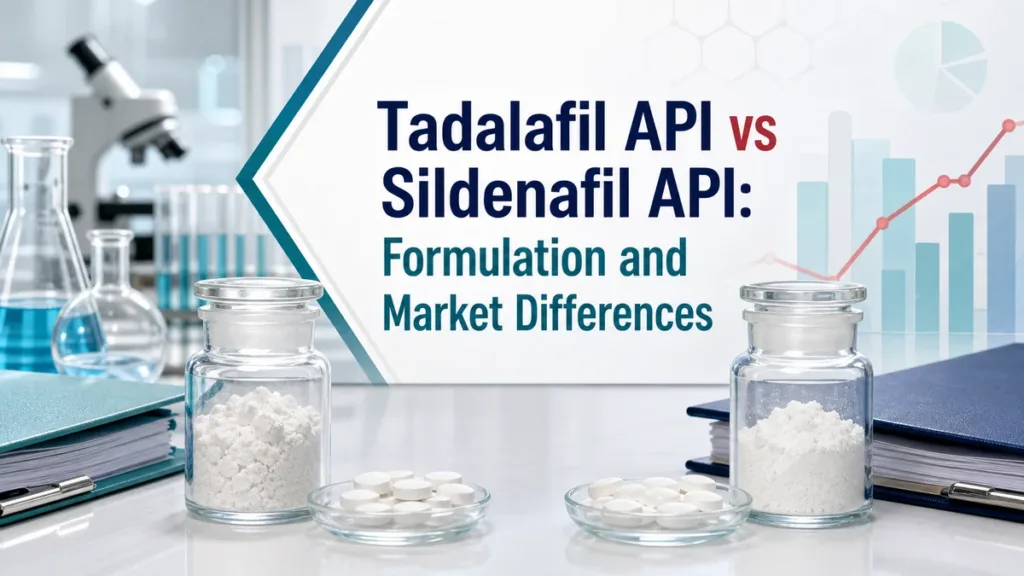
Tadalafil API and Sildenafil API both belong to the PDE5 inhibitor category, but B2B pharma buyers should not treat them as interchangeable raw materials. The better API choice depends on the finished product strategy, formulation route, target market, dosage form, supplier documentation, regulatory file and commercial positioning.
This guide compares Tadalafil API vs Sildenafil API for formulation teams, CDMOs, generic manufacturers, importers, distributors and sourcing managers. It does not provide patient advice, dosing guidance or consumer purchase recommendations.
Buyers already evaluating Tadalafil can review Pharmint’s Tadalafil API supplier for bulk B2B sourcing. Buyers still mapping broader raw-material options can start from Pharmint’s active pharmaceutical ingredients and raw materials category.
Tadalafil API vs Sildenafil API: Quick B2B Comparison
| Factor | Tadalafil API | Sildenafil API |
| Main API category | PDE5 inhibitor API | PDE5 inhibitor API |
| Common finished-product positioning | Longer-duration ED products and other approved Tadalafil product routes | High-recognition, on-demand ED products |
| U.S. label reference | Cialis / Tadalafil products | Sildenafil citrate tablets |
| Formulation focus | Low-solubility API; dissolution and bioavailability strategy matter | Often supplied as Sildenafil citrate; salt form, dissolution and food-effect considerations matter |
| Commercial buyer fit | Manufacturers, CDMOs and buyers seeking differentiated ED portfolio positioning | Manufacturers and buyers seeking a widely recognized ED API category |
| Procurement focus | Specification, COA, GMP, DMF/CEP support, impurity profile and sample testing | Specification, salt/base form, COA, GMP, impurity profile, supplier route and sample testing |
Why API Buyers Compare Tadalafil and Sildenafil
Tadalafil and Sildenafil are often compared because both are PDE5 inhibitors used in ED-related product categories. For B2B buyers, the comparison is not about which medicine is better for a patient. It is about which API fits the buyer’s formulation, regulatory and market plan.
-
PDE5 Inhibitor APIs Serve Different Product Strategies
Sildenafil is strongly associated with on-demand ED products and long-standing market recognition. Tadalafil is often positioned around longer-duration product strategies and broader Tadalafil product routes. A buyer choosing between the two should define the target dosage form, strength, market authorization route, dossier needs, packaging, expected order volume and supplier-document requirements before requesting prices.
-
Separate API Sourcing From Patient-Facing Medicine Comparisons
Patient-facing pages often discuss onset, duration, food, side effects and consumer cost. API sourcing requires a different lens: chemical identity, salt or base form, pharmacopeial grade, particle size, residual solvents, related substances, GMP evidence, DMF or CEP support, sample testing, import route and formulation compatibility.
Formulation Differences Between Tadalafil API and Sildenafil API
The formulation difference starts with the API’s physicochemical profile. PubChem identifies Tadalafil with molecular formula C22H19N3O4 and Sildenafil with molecular formula C22H30N6O4S. Those identities need to be connected to the supplier’s exact material, specification and batch documentation.
-
Solubility, Dissolution and Bioavailability Considerations
Tadalafil is commonly discussed as a low-solubility API. A 2025 formulation study describes Tadalafil as a BCS Class II compound with low solubility and high permeability. For a formulation team, this means dissolution strategy, particle-size control, excipient selection and bioavailability planning can materially affect product development.
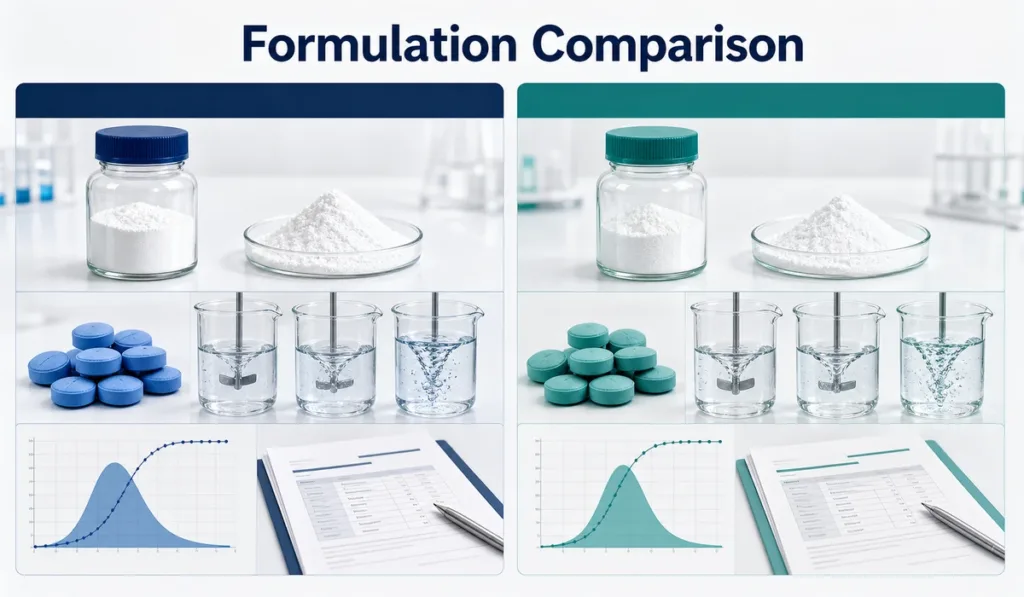
Sildenafil formulation work often focuses on the supplied form, especially Sildenafil citrate, and how dissolution, pH behavior and dosage form affect release. A review of Sildenafil formulation and analytical strategies notes that Sildenafil citrate is used to improve water solubility versus the free base.
-
Salt Form, Particle Size and Specification Review
Buyers should not compare Tadalafil API and Sildenafil API only by assay. For Tadalafil, ask for particle-size distribution, polymorph or solid-state information where relevant, related substances, residual solvents, water content, storage condition and retest period. For Sildenafil, confirm whether the quote is for Sildenafil base, Sildenafil citrate or another form, and whether the specification matches the intended dosage form.
-
Tablet Strengths and Dosage-Form Planning
DailyMed’s Sildenafil label lists Sildenafil citrate tablets in 25 mg, 50 mg and 100 mg strengths. Tadalafil products have different finished-dose planning considerations, and Cialis labeling identifies Tadalafil tablets for oral use. Strength, route and label status should be reviewed by product and market, not inferred from the API name alone.
Pharmacokinetic Differences That Shape Market Positioning
Pharmacokinetic differences do not replace formulation work, but they do shape commercial positioning. A peer-reviewed pharmacokinetic review describes Sildenafil’s half-life as about 3 to 4 hours and Tadalafil’s half-life as about 18 hours.
-
Sildenafil API Supports Fast On-Demand Product Positioning
DailyMed’s Sildenafil label states that maximum observed plasma concentrations are reached within 30 to 120 minutes in the fasted state. The same label states that a high-fat meal delays Tmax by 60 minutes and reduces Cmax by 29%. For B2B buyers, this supports why Sildenafil products are often framed around on-demand use and why food-effect language, label review and dosage-form performance matter.
-
Tadalafil API Supports Longer-Duration Product Positioning
Tadalafil’s longer half-life (~17.5 hours) supports differentiated product positioning compared with Sildenafil (3–5 hours), enabling once-daily or on-demand dosing strategies. That does not mean a buyer can skip formulation or regulatory review. It means the API decision should account for the intended product claim, label route, dosage strength, market demand, and supplier-document readiness.
Market Differences for B2B Pharma Buyers
Market fit depends on product strategy. A buyer may choose Sildenafil API for a high-recognition ED product category, Tadalafil API for differentiated longer-duration positioning, or both APIs for a broader PDE5 portfolio.
-
Sildenafil API Market Fit
Sildenafil API may fit buyers developing or sourcing products around high brand recognition, established ED demand and on-demand product positioning. Buyers comparing this route can review Pharmint’s Sildenafil Citrate API supplier page. Procurement teams should still verify API form, specification, GMP evidence, COA, impurity profile, sample testing, and documentation support before selecting a supplier.
-
Tadalafil API Market Fit
Tadalafil API may fit buyers that want a differentiated PDE5 inhibitor API with strong relevance to longer-duration ED product strategies. Pharmint’s Tadalafil API supplier for bulk B2B sourcing page is the best internal destination when the buyer has moved from comparison to a Tadalafil-specific sourcing inquiry.
-
When a Buyer May Source Both APIs
Some buyers may source both APIs to support different finished-product strategies. In that case, the buyer should avoid treating the two supplier files as identical. Each API needs its own specification, COA, GMP evidence, impurity profile, regulatory-support review, sample test plan, packaging, retest-date requirement and change-control expectations.
Documentation and Supplier Checks for PDE5 Inhibitor APIs
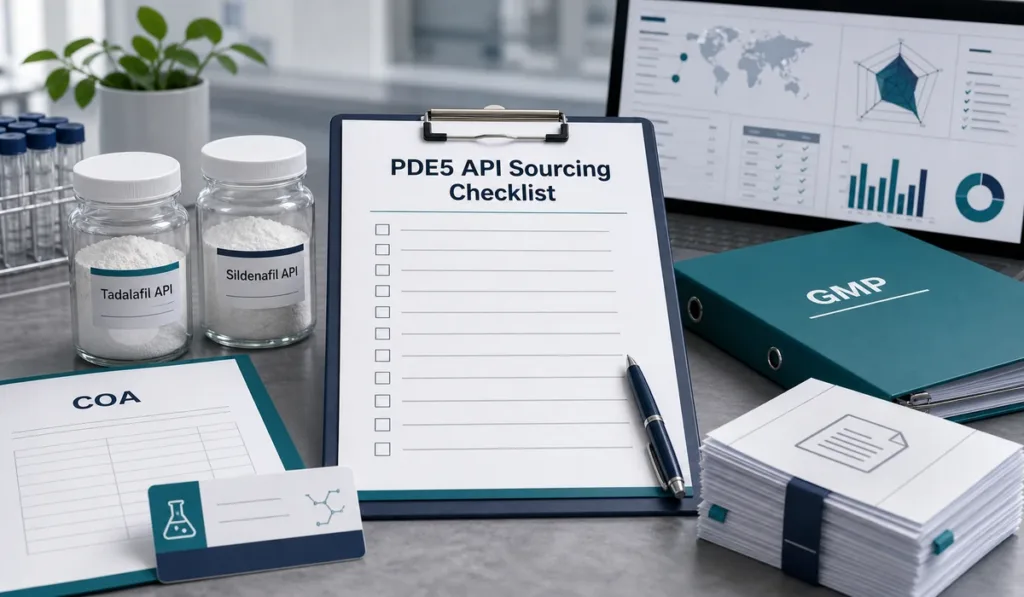
Supplier documents should decide whether an API conversation is ready for RFQ comparison. Price only matters after the buyer confirms the API identity, grade, document package and supplier role.
-
COA, GMP, DMF or CEP Support
For both APIs, request a batch-specific or representative COA, GMP evidence tied to the manufacturing site, specification, SDS, stability or retest data, residual-solvent data, related-substance profile and regulatory-support documents where relevant. For Tadalafil specifically, Pharmint’s Tadalafil API documentation guide explains how to interpret DMF, USDMF, CEP and GMP claims.
-
Sample Testing, Impurity Profile and Change Control
Before bulk purchase, request a sample under documented terms and test it through a qualified lab. Ask suppliers how they manage impurity-profile changes, process changes, site changes, retest extensions, packaging changes and notification timelines. This matters for both Tadalafil API and Sildenafil API because formulation and regulatory files depend on consistent API quality.
For a deeper Tadalafil-specific supplier review, use Pharmint’s guide on how to verify a Tadalafil API supplier.
Source Tadalafil API and Compare PDE5 API Options Through Pharmint
Pharmint helps qualified buyers move from API comparison to structured sourcing. Buyers can define whether they need Tadalafil API, Sildenafil API or broader PDE5 API options, then prepare an RFQ with product route, quantity, destination market, specification, documentation needs, sample requirement, packaging, Incoterms and timeline.
For Tadalafil-specific sourcing, review Pharmint’s Tadalafil API supplier for bulk B2B sourcing. For Sildenafil-specific sourcing, review Pharmint’s Sildenafil Citrate API supplier page. For broader API discovery, use the API active pharmaceutical ingredients category. If your team is ready to compare documented supplier options, request a structured quote.
Pharmint does not replace buyer QA, RA, legal, formulation, customs or regulatory review. Final supplier qualification, formulation acceptance, regulatory use and batch release remain the buyer’s responsibility.
Tadalafil API vs Sildenafil API FAQs
What is the main difference between Tadalafil API and Sildenafil API?
Tadalafil API and Sildenafil API are both PDE5 inhibitor APIs, but they support different product strategies. Tadalafil is often linked to longer-duration positioning, while Sildenafil is strongly linked to on-demand ED products.
Is Tadalafil API harder to formulate than Sildenafil API?
Tadalafil is commonly discussed as a low-solubility API, so dissolution and bioavailability strategy matter. Sildenafil formulation depends heavily on the exact form, such as Sildenafil citrate, and the target dosage form.
Which API has stronger market demand, Tadalafil or Sildenafil?
Both APIs have strong ED-market relevance. Sildenafil has high recognition and on-demand positioning, while Tadalafil has differentiated longer-duration positioning. Buyers should choose based on market plan and product route.
What documents should buyers request for Tadalafil API or Sildenafil API?
Buyers should request COA, GMP evidence, specification, SDS, impurity profile, residual-solvent data, stability or retest data, sample details and DMF or CEP support where relevant.
Can Pharmint help compare Tadalafil API and Sildenafil API suppliers?
Pharmint can help structure API sourcing requirements and supplier-document questions. Final supplier approval, formulation acceptance and regulatory use should remain with the buyer’s qualified teams.
Sources
- DailyMed: Sildenafil citrate tablets prescribing information
- DailyMed: Cialis / Tadalafil prescribing information
- Peer-reviewed review: Pharmacokinetic issues of first-generation PDE5 inhibitors
- PubChem: Tadalafil
- PubChem: Sildenafil
- Peer-reviewed study: Tadalafil solubility and dissolution-rate enhancement
- Peer-reviewed review: Sildenafil formulation and analytical strategies

