

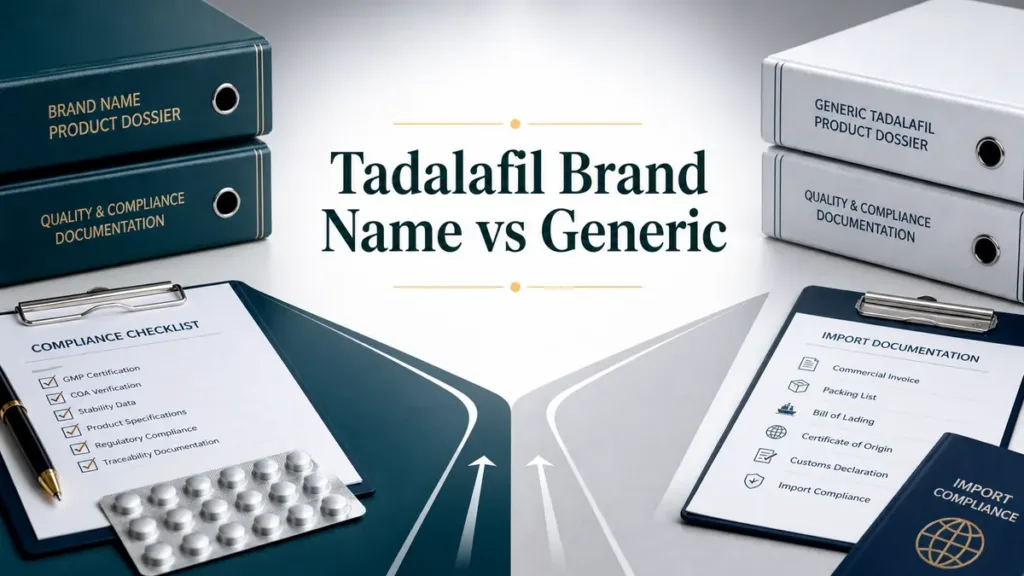
Brand-name Cialis, authorized generic and generic tadalafil require different evidence checks before B2B sourcing.
A tadalafil supplier quote can look simple until the buyer asks one question: is the product being offered as brand-name Cialis, an authorized generic, an ANDA-approved generic tadalafil product, or something else entirely? For US distributors and importers, that distinction affects the evidence file behind the quote: application holder, labeler, NDC, package configuration, trading-partner status, import records and shipment release controls.
This guide explains how to interpret tadalafil brand-name and generic language before comparing suppliers, so procurement teams can separate useful product identity from risky shorthand.
Tadalafil Brand Name: Quick Answer for B2B Buyers
Cialis is the best-known US brand name for tadalafil in the erectile dysfunction and benign prostatic hyperplasia category. Tadalafil also appears in other US brand-name or branded products depending on indication and formulation, including Adcirca, Alyq, Tadliq, Chewtadzy and certain combination products.
For B2B buyers, the important point is not only “tadalafil equals Cialis.” The important point is whether the offered product is:
- a brand-name product approved under a New Drug Application;
- an authorized generic marketed under the brand product’s NDA but without the brand name on the label;
- an ANDA-approved generic tadalafil product;
- a foreign-market product that is not automatically eligible for US commercial distribution; or
- an API or unfinished material, which belongs in a different sourcing route.
That route should be defined before price, lead time or sample requests are compared.
Why Tadalafil Brand vs Generic Matters in US Distribution
Brand and generic language changes the evidence a buyer should request. A finished tadalafil tablet offer for US distribution should not be evaluated only by active ingredient and strength. The buyer needs to reconcile the product label, application record, NDC, manufacturer or packager role, trading-partner authorization and shipment documents.
FDA says FDA-approved generic medicines work the same way and provide the same clinical benefit and risks as their brand-name counterparts. FDA also says generic medicines must be the same as the brand-name medicine in dosage, safety, effectiveness, strength, stability, quality and how they are taken. That supports the regulatory concept of generic substitution, but it does not remove the buyer’s obligation to verify the exact product being sourced.
-
Brand-Name Cialis, Authorized Generic and ANDA Generic Are Not the Same Sourcing Route
A brand-name Cialis product points buyers toward the NDA holder, brand label, NDC, approved label and authorized commercial distribution route. A conventional generic tadalafil product points buyers toward an ANDA holder, therapeutic equivalence evidence, labeler information and generic product labeling. An authorized generic is different again: FDA describes it as the approved brand-name drug marketed without the brand name on its label.
That distinction matters in an RFQ. A supplier saying “generic Cialis” may mean an ANDA generic, an authorized generic, a foreign brand, a private-label product, a repackaged product or simply a shorthand phrase used for search. The buyer should ask for the records that prove which route applies.
-
Brand References Do Not Replace Product-Specific Evidence
For US commercial distribution, a brand reference such as “Cialis equivalent” is not enough. Buyers should ask for the exact product name, active ingredient, strength, dosage form, labeler, NDC, application number where applicable, manufacturer or packager identity, package presentation and market status.
If the supplier cannot connect the quote to a product-specific record, pause the conversation before requesting commercial quantities. Product identity gaps become harder to fix after payment, shipment booking or customs entry.
How to Verify Brand-Name Cialis and Generic Tadalafil in FDA Records
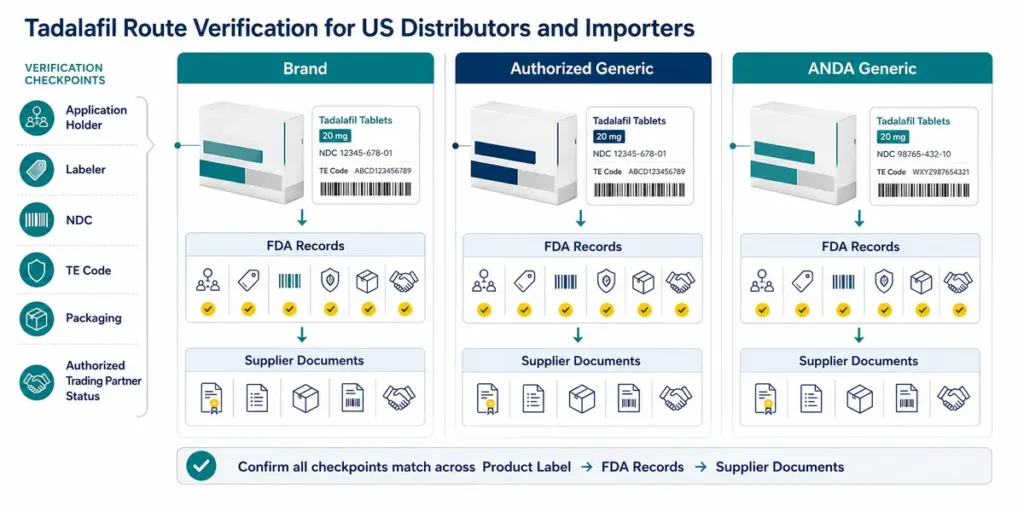
US distributors and importers should verify tadalafil product identity through primary records instead of supplier screenshots. The goal is to confirm whether the product offered by the supplier matches the FDA-facing product, label and distribution route.
-
Use Orange Book and DailyMed to Check Application and Label Evidence
FDA’s Orange Book identifies approved drug products and therapeutic equivalence evaluations. It can help buyers check approved application information, proprietary name, active ingredient, dosage form, route, strength and therapeutic equivalence codes where available.
DailyMed provides official labeling information submitted to FDA. For Cialis, the DailyMed label was updated June 3, 2026, shows a March 2026 revision date, and lists tadalafil as the active ingredient. It also lists product information for 5 mg, 10 mg and 20 mg Cialis tablets.
Use these records to ask supplier-side questions:
- Does the offered product name match the label or application record?
- Does the strength and dosage form match the product being quoted?
- Does the labeler or application holder match the seller’s claim?
- Does the NDC on the product evidence match the package being offered?
- Is the product an NDA brand, authorized generic, ANDA generic or another route?
-
Match NDC, Labeler, Strength and Dosage Form Before Comparing Quotes
The NDC is a product identifier used in US drug listing and distribution records. It is not a substitute for full due diligence, but it is a useful reconciliation point. Buyers should compare the NDC, labeler, package configuration, strength and dosage form across the supplier quote, product label, invoice, packing list and any FDA-facing record.
If one document names a brand product, another document shows generic tadalafil, and a third shows a different labeler or packager, the supplier should explain the relationship in writing before the buyer proceeds.
Brand Name Cialis vs Generic Tadalafil: Distributor Comparison Table
| Route | What it usually means | What US buyers should verify |
| Brand-name Cialis | Branded tadalafil product associated with the approved brand label and NDA route. | NDA/application evidence, labeler, NDC, authorized supply chain, package and trading-partner controls. |
| Authorized generic | Approved brand-name drug marketed without the brand name on the label under the brand product’s NDA. | NDA holder relationship, authorized generic status, label differences, NDC, packaging and distribution authorization. |
| ANDA generic tadalafil | Generic product approved through an Abbreviated New Drug Application referencing a brand-name product. | ANDA holder, therapeutic equivalence where applicable, labeler, NDC, manufacturing or packaging site, package and market status. |
| Foreign tadalafil brand | Product approved or marketed outside the US. | Do not assume US eligibility. Verify whether any lawful US commercial route exists, plus application, label, import and distribution evidence. |
| Tadalafil API | Active pharmaceutical ingredient or unfinished material. | Treat as API sourcing, not finished-drug distribution. Verify manufacturer, site, specification, COA, DMF or regulatory support and import route. |
Importer and Distributor Checks Before a Tadalafil RFQ
Before asking for price, define the product route in the RFQ. A useful tadalafil RFQ should tell suppliers whether the buyer is evaluating brand-name Cialis, authorized generic tadalafil, ANDA generic tadalafil, a foreign-market product, private-label supply or API.
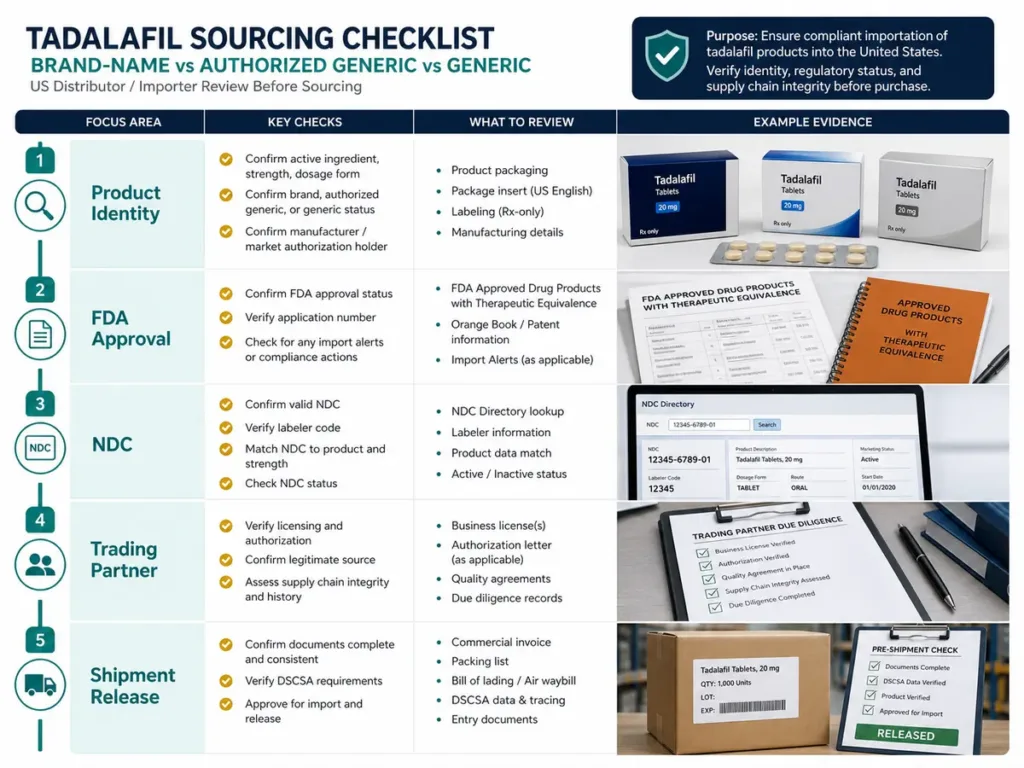
Importers and distributors should confirm product identity, application evidence, label data, trading-partner authorization and shipment records.
1. Confirm Drug Application, Registration and Listing Evidence
FDA’s importing-human-drugs guidance says imported drugs must meet standards for quality, safety and effectiveness, and that FDA verifies requirements such as registration, listing, drug application, labeling and cGMPs. For importers, the practical translation is simple: the entry file should match the product route being declared.
Ask suppliers for:
- product name, active ingredient, strength, dosage form and pack;
- application number or regulatory route where applicable;
- labeler and NDC information;
- manufacturing, repackaging or relabeling site identity;
- registration and listing evidence where applicable;
- label, carton and package insert evidence;
- COA, batch number, expiry and remaining shelf life;
- commercial invoice, packing list and shipment route;
- Affirmations of Compliance information where relevant; and
- written explanation for any mismatch across seller, manufacturer, labeler, invoice party and payment beneficiary.
2. Confirm Trading-Partner Authorization and Shipment Records
For US wholesale distribution, supplier identity is not only a commercial issue. FDA says prescription drugs should only be purchased from wholesale drug distributors with a valid US license and authorization under law, and that unlicensed or unauthorized trading partners create risk of unsafe, counterfeit, stolen or diverted drugs.
Before placing a purchase order, check whether the counterparty is operating in the role it claims: manufacturer, authorized distributor, wholesale distributor, 3PL, repackager, relabeler, exporter or broker. Then confirm that the role is compatible with the buyer’s intended US activity.
Counterfeit and Unauthorized Cialis Risks for B2B Buyers
Brand-name tadalafil searches often attract counterfeit and unauthorized product risk because Cialis is a recognizable brand. FDA has warned about counterfeit Cialis tablets entering the United States and noted that products from unknown sources may not follow US manufacturing, quality, storage or handling standards.
B2B buyers should treat counterfeit risk as a document-reconciliation problem, not only a visual packaging problem. Red flags include:
- brand-name packaging offered through an unclear trading partner;
- no NDC or a mismatched NDC on product evidence;
- misspelled brand, company or manufacturer information;
- label images that do not match official label or package records;
- seller refusal to identify the manufacturer, labeler or packager;
- pressure to approve payment before application, NDC or trading-partner evidence is reviewed;
- shipment documents that do not match the quoted product, quantity, batch or pack.
If the requirement is a legitimate US commercial route, the buyer’s qualified QA, regulatory, legal, customs and distribution teams should review the evidence before funds move.
How Pharmint Supports Tadalafil Brand and Generic Sourcing Decisions
Pharmint helps qualified B2B buyers move from vague tadalafil supplier language to structured sourcing conversations. Buyers can define whether they need API, finished tablets, brand-reference comparison, generic tadalafil, documentation review, sample coordination or supplier shortlisting before offers are compared.
For USA-specific route selection, use Pharmint’s Tadalafil procurement checklist for USA buyers. For broader supplier discovery, review Pharmint’s Tadalafil suppliers and exporter paths. If the finished-dose requirement is clear, the Tadalafil 20 mg tablets for bulk B2B orders page can be used as a product-level inquiry starting point.
Pharmint does not replace buyer-side regulatory review, legal advice, customs review, DSCSA review or final supplier qualification. The value is in structuring the RFQ and supplier conversation so the buyer can compare documented options, not shorthand claims.
If your team is ready to compare documented options, request a structured Tadalafil quote. Include the product route, target market, required evidence, quantity, sample requirement, target Incoterm, shelf-life requirement and timeline.
Tadalafil Brand Name vs Generic FAQs
What is the brand name of tadalafil?
Cialis is the best-known brand name for tadalafil in the US ED/BPH context. Other tadalafil-containing US brands or branded products include Adcirca, Alyq, Tadliq, Chewtadzy and certain combination products, depending on indication and formulation.
Is tadalafil the same as Cialis?
Tadalafil is the active ingredient. Cialis is a brand-name product containing tadalafil. A generic tadalafil product may be FDA-approved when it meets the required standards for active ingredient, strength, dosage form, route, bioequivalence, quality and labeling.
What is the difference between generic tadalafil and an authorized generic?
FDA describes an authorized generic as the approved brand-name drug marketed without the brand name on its label. A conventional generic is developed by another company and approved through an ANDA. Buyers should verify which route applies before comparing offers.
Can a US importer buy foreign Cialis or tadalafil because the active ingredient is the same?
No simple assumption should be made. US import and distribution require product-specific evidence. The importer should verify application status, labeling, registration/listing, manufacturer, labeler, NDC, cGMP context, trading-partner status and shipment records for the intended route.
What should a Tadalafil brand-vs-generic RFQ include?
Include product route, brand or generic status, active ingredient, strength, dosage form, pack, destination market, required application or listing evidence, labeler/NDC details, manufacturer and site information, batch documents, shipment records, trading-partner requirements and timeline.
Where should buyers go after confirming the product route?
If the buyer needs a US route-selection framework, use Pharmint’s USA tadalafil procurement checklist. If the buyer needs supplier discovery, use the Tadalafil supplier hub. If the requirement is a finished 20 mg tablet inquiry, use the Tadalafil 20 mg product page and request product-specific evidence before approving a quote.