Semaglutide API bulk price is not a single public number that serious B2B buyers should rely on. A useful Semaglutide API quote depends on the buyer’s quantity, product form, specification, documentation scope, supplier qualification, batch status, lead time, shipment route, destination market and commercial terms.
This guide is written for qualified pharmaceutical procurement, QA, regulatory affairs, formulation, CRO/CDMO, importer, distributor and institutional sourcing teams. It is not medical advice, dosage guidance, consumer purchasing support or a recommendation to buy unapproved products.
For product-level details, buyers can review Pharmint’s Semaglutide API product page. Use this article to prepare the commercial and documentation inputs that make supplier quotes easier to compare.
Semaglutide API Bulk Price Depends on the RFQ Scope
A supplier cannot give a reliable Semaglutide API bulk price from the product name alone. The quote changes when the buyer needs a sample, pilot quantity, kilogram-scale supply, a specific assay range, a defined impurity profile, GMP evidence, COA and SDS support, regulatory-document references, a tight dispatch window, or export documents for a specific destination.
That is why quote-based sourcing is safer than publishing fixed public prices for a regulated API inquiry. A low headline price can become expensive if it excludes documents, requires retesting, uses an unsuitable Incoterm, cannot support the destination market, or leaves the buyer with unresolved supplier-verification risk.
What to Include in a Semaglutide API RFQ
- Product identity: Semaglutide API, CAS 910463-68-2, required form, grade and specification.
- Quantity: sample, pilot order, commercial order, annual forecast or recurring supply plan.
- Destination market: country of import, buyer type, intended B2B use and import-review needs.
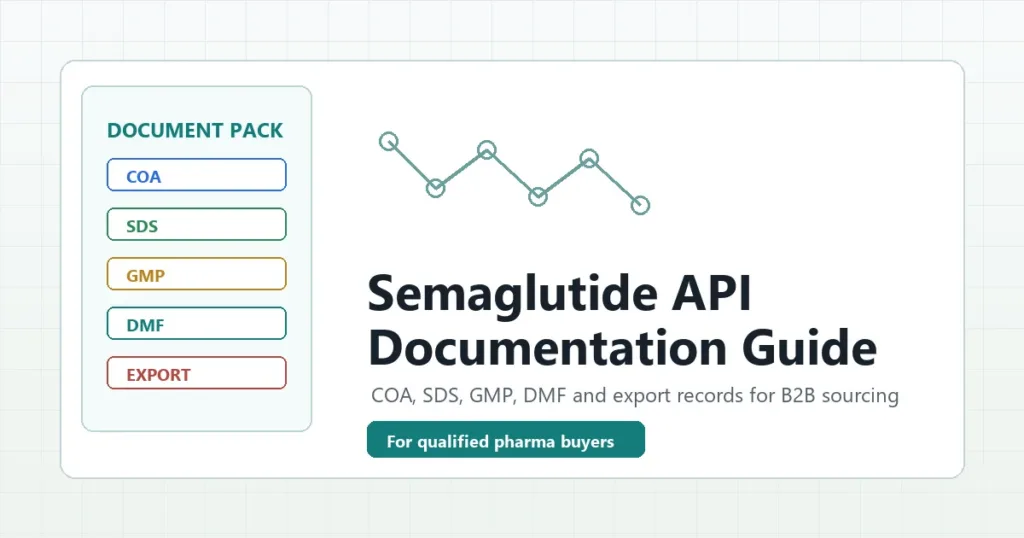
- Documentation scope: COA, SDS or MSDS, specification sheet, GMP evidence, impurity profile, stability information, DMF or CEP references where relevant, certificate of origin and export documents.
- Batch status: released inventory, reserved batch, pending QC release or made-to-order production.
- Commercial terms: Incoterm, currency, freight responsibility, payment route, sample policy and quote validity.
- Timeline: target dispatch date, target arrival date, internal QC review window and document-review deadline.
Semaglutide API MOQ: Why Minimum Order Quantity Changes
MOQ, or minimum order quantity, is the smallest quantity a supplier or manufacturer will accept for an order. In pharmaceutical sourcing, MOQ is not only a sales preference. It can reflect batch economics, packaging format, document preparation, QC testing, inventory allocation, export requirements and buyer qualification.
For Semaglutide API, buyers may see very different MOQ positions across supplier types. A supplier may offer small evaluation quantities only to qualified buyers, while commercial documentation and better unit economics may require kilogram-scale or forecast-backed orders. The key question is not only “What is the MOQ?” but “What does this MOQ include?”
MOQ Drivers Buyers Should Clarify Before Comparing Suppliers
- Order purpose: analytical evaluation, formulation development, commercial manufacturing support and distribution supply may have different minimums.
- Batch economics: peptide synthesis, purification, release testing and document preparation include fixed costs that affect minimum viable quantities.
- Product form and specification: API, salt form, reference standard, intermediate and finished dosage products are not interchangeable.
- Documentation access: detailed quality and regulatory packages may be reserved for qualified buyers with serious commercial requirements.
- Packaging and storage: grams, vials, sealed bottles, kilogram packs and drum formats create different handling and logistics costs.
- Supply relationship: repeat orders, annual forecasts and framework agreements can improve MOQ flexibility compared with one-off spot purchases.
Key Semaglutide API Bulk Price Factors Buyers Should Compare
-
Order Quantity and Volume Brackets
Semaglutide API unit price usually changes across sample, pilot and commercial volumes. A small evaluation order, a kilogram-scale pilot order and a forecasted commercial supply agreement should not be compared as if they represent the same supplier commitment. Ask for volume brackets and make the supplier state whether each bracket is tied to released stock, future production or a supply contract.
-
Product Form, Assay and Impurity Profile
Product identity is the first price-control point. Buyers should confirm whether the quote is for Semaglutide API, a salt form, a reference standard, an intermediate, a research-use material or a finished product. Semaglutide is listed in PubChem with CAS 910463-68-2 and molecular formula C187H291N45O59, but supplier quotes still need batch-specific confirmation through COA and specification documents.
Assay, purity, impurity limits, residual solvents, water content, microbial attributes, analytical methods and storage requirements can all affect price. A quote that looks cheaper may not support the buyer’s required specification or destination-market review.
-
COA, SDS, GMP Evidence and Regulatory Documents
Documentation is often one of the biggest reasons Semaglutide API supplier quotes differ. Buyers should request a document package before comparing price alone. At minimum, ask whether the supplier can provide batch-specific COA, SDS or MSDS, specification sheet, GMP or cGMP evidence, impurity data, stability information, packaging details, export documents and regulatory-document references where relevant.
For U.S.-linked sourcing decisions, FDA’s Import Alert 66-80 is important context. FDA states that it evaluated 48 GLP-1 API sites in the U.S. supply chain and found 21% noncompliant under section 501 or nonresponsive to records requests. This does not mean every Semaglutide API supplier is unsuitable, but it does show why buyers should ask for site-specific and batch-specific evidence instead of relying on price claims.
For broader supplier-quality checks, Pharmint’s guide on GMP-certified API manufacturers explains how buyers can review certification scope, inspection history, DMF or dossier claims, COA availability and supplier transparency before approving a source.
-
Batch Status, Lead Time and Allocation
Lead time changes the quote because available stock, reserved batches and made-to-order production carry different costs and risks. A fast quote may mean released inventory is available, but buyers still need to verify the batch number, COA date, retest date, storage condition, allocation status and shipment-document readiness.
A longer lead time is not automatically a weakness if it supports better documentation, a suitable batch size, planned QC release and a clearer export route. Buyers should separate manufacturing time, release testing, document preparation, freight booking and customs-document timing before judging a quote.
-
Packaging, Storage and Shipment Route
Semaglutide API handling requirements should be confirmed through supplier documents and the batch-specific SDS or specification. Packaging format, label content, closure integrity, liner type, storage statement, temperature-control needs, route duration and export packaging can affect both price and procurement risk.
Buyers sourcing into specific markets should prepare destination details early. For example, Pharmint’s Semaglutide API Nigeria sourcing guide explains how buyer type, documents, import checks and destination-country requirements shape the ordering process for Nigerian buyers.
-
Incoterms, Payment Terms and Quote Validity
EXW, FOB, CIF and DDP quotes are not directly comparable. A lower unit price may exclude freight, insurance, customs brokerage, duties, document corrections and local delivery. Ask suppliers to quote on the same Incoterm basis whenever possible, and separate the API unit price from freight and import assumptions.
Payment terms also affect risk. A quote should state currency, validity period, payment milestones, batch-reservation conditions, refund or deviation terms, sample policy and responsibilities if documents are incomplete or shipment timing changes.
Why Public Semaglutide API Prices Can Mislead Buyers?
Public Semaglutide API prices found in directories, marketplaces or research-use listings may be useful for discovery, but they are not a substitute for a formal supplier quotation. Public prices can mix different product forms, grades, pack sizes, intended uses, documentation levels, supplier types, and shipment assumptions.
In GLP-1 sourcing, price-only comparison is especially risky because the buyer may need documentation that is not included in the public listing. A supplier page may mention purity or MOQ, but the buyer still needs to confirm COA, SDS, GMP evidence, impurity profile, storage, batch traceability, regulatory references where applicable, export documents and the actual manufacturer or site behind the material.
Semaglutide API Landed Cost vs Unit Price
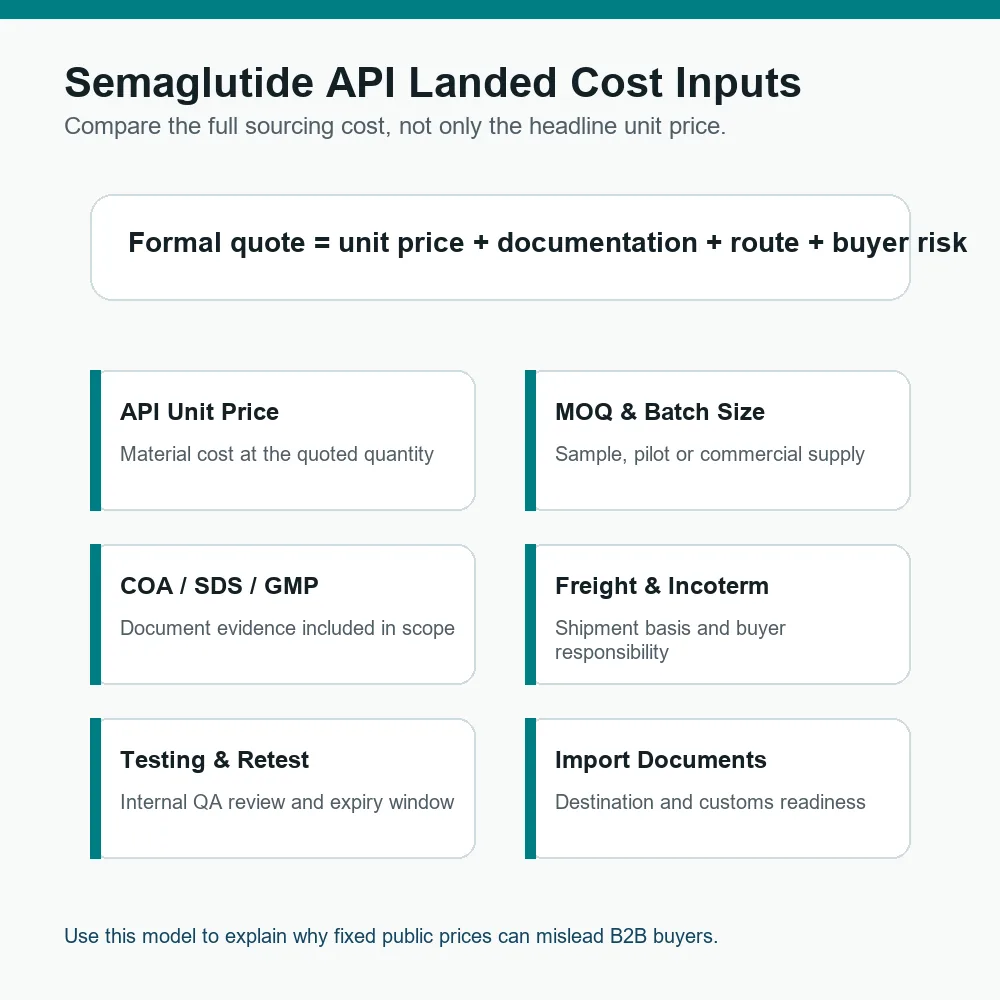
A Semaglutide API quote should be compared by landed cost and procurement risk. Landed cost includes the API unit price, freight, insurance, duties, customs brokerage, document preparation, retesting, internal QA review, supplier qualification, payment risk, cold-chain or controlled-route needs where applicable, and the cost of switching suppliers if documentation does not support the buyer’s end use.
FDA’s GLP-1 policy environment also reinforces why buyers should avoid shortcuts. FDA stated that the semaglutide injection product shortage was resolved on February 21, 2025 on its GLP-1 compounding policy update. FDA also announced on April 30, 2026 that it proposed excluding semaglutide, tirzepatide and liraglutide from the 503B bulks list. These are U.S.-specific policy references, but they are useful reminders that API sourcing decisions should be documented, qualified and reviewed for the buyer’s market.
Quote Comparison Checklist for Semaglutide API Buyers
| Quote Field | Why It Matters | Buyer Action |
| API identity and CAS | Confirms the quote is for Semaglutide API, not a salt form, reference standard, intermediate or finished product. | Match the quote to Semaglutide CAS 910463-68-2 and the required specification. |
| MOQ and quantity tier | Shows whether the offer is a sample, pilot batch or commercial supply position. | Ask for quantity breaks, annual forecast assumptions and sample policy. |
| Assay and impurity profile | Different specifications can change price and downstream suitability. | Request batch COA, test methods, impurity limits and release criteria. |
| Document package | A lower price may be unsuitable if documents do not support QA, import or regulatory review. | Confirm COA, SDS/MSDS, GMP evidence, stability, packaging, export documents and regulatory references where relevant. |
| Supplier and site evidence | GLP-1 API sourcing has heightened quality and traceability risk. | Ask for manufacturer identity, site details, audit evidence and batch traceability where available. |
| Batch status and lead time | Separates released stock from future production or uncertain allocation. | Confirm batch number, COA date, retest date, QC release status and reservation conditions. |
| Incoterm and freight | Changes landed cost and buyer responsibility. | Compare quotes on the same shipment basis and separate product cost from logistics cost. |
How Pharmint Helps Buyers Request Semaglutide API Quotes
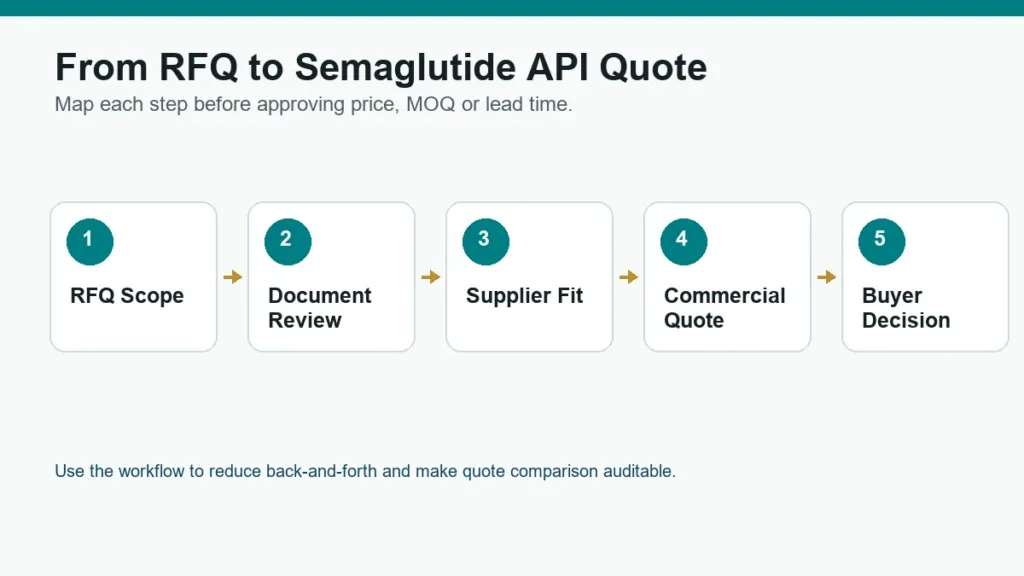
Pharmint supports qualified B2B buyers by turning vague price inquiries into structured sourcing requests. Instead of asking only for the cheapest Semaglutide API bulk price, buyers can submit the product identity, quantity, destination, buyer type, intended use, documentation requirements, timeline and commercial terms needed for quote comparison.
Use Pharmint’s Semaglutide API product page when the requirement is ready for supplier discussion. Use the request-quote workflow when your team wants supplier responses compared against a clear RFQ scope. Pharmint’s cost-estimator content can also help buyers think about estimated costs, MOQ and delivery timelines before requesting a formal quote.
Pharmint should be positioned as a documentation-led sourcing layer, not as a source of unsupported fixed prices. The commercial value is helping buyers prepare better RFQs, compare supplier responses, request documents, and reduce back-and-forth before purchase-order or compliance review.
Semaglutide API Bulk Price and MOQ FAQs
What affects Semaglutide API bulk price the most?
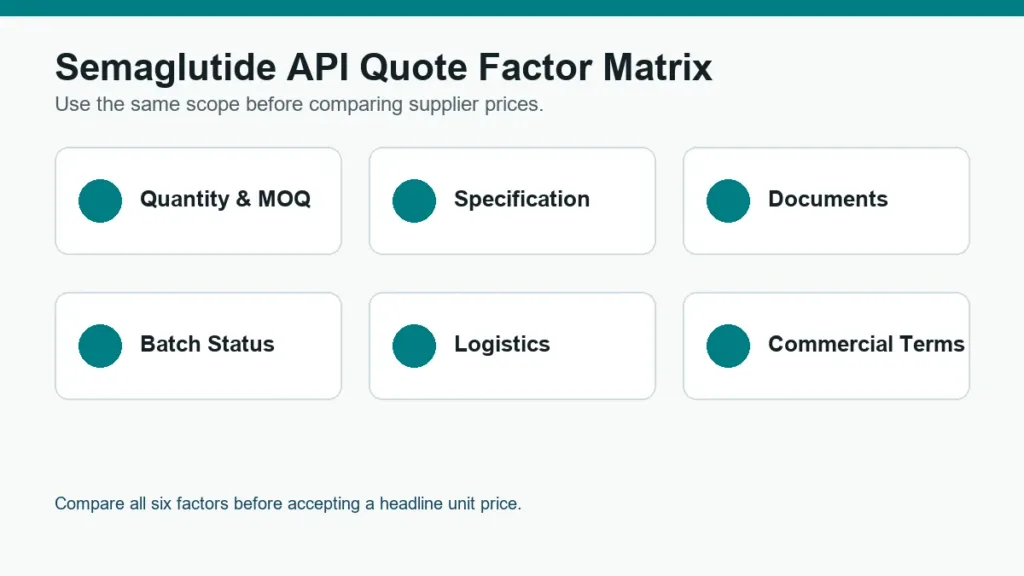
The main factors are quantity, product form, assay and impurity requirements, documentation package, GMP or site evidence, batch status, lead time, packaging, destination market, shipment route, Incoterm, payment terms and supplier availability.
What is the MOQ for Semaglutide API?
Semaglutide API MOQ is supplier-dependent and should be confirmed during inquiry. Buyers should state whether they need a sample, pilot quantity or commercial supply and ask what documentation is included at each quantity tier.
Why do Semaglutide API quotes vary between suppliers?
Quotes vary because suppliers may offer different product forms, grades, batch status, document packages, manufacturing sites, shipment routes, lead times and payment terms. Compare the full RFQ scope, not only the unit price.
Should buyers rely on public Semaglutide API prices?
Public prices should be treated as directional discovery only. Formal procurement quotes should include batch-specific quality documents, supplier identity, shipment terms, document scope, lead time and destination-market assumptions.
What documents should be requested before approving a Semaglutide API quote?
Buyers should request COA, SDS or MSDS, specification sheet, impurity profile, GMP evidence where applicable, stability information, packaging and storage details, export documents and regulatory-document references where relevant to the destination market.
How can buyers get a more accurate Semaglutide API quote?
Send a structured RFQ with product identity, CAS number, required quantity, destination country, buyer type, intended use, required documents, timeline, packaging expectations, Incoterm preference and internal QA or regulatory review needs.
Request a Semaglutide API Quote with Clear Commercial Inputs
If your team is evaluating Semaglutide API suppliers, prepare the RFQ before asking for the lowest price. Include quantity, product form, specification, destination, documentation requirements, lead-time target, shipment basis and buyer qualification details.
Request a structured Semaglutide API quote through Pharmint so supplier responses can be reviewed by commercial terms, document evidence, MOQ, lead time and destination-market fit.
Compliance note: This article is for qualified B2B sourcing and procurement education only. It does not provide medical advice, treatment claims, dosage guidance, consumer purchase support, compounding instructions, regulatory approval confirmation or supplier certification guarantees. Buyers are responsible for confirming supplier, product, import and end-use requirements in their destination market.